
19/06/2026
Is Airbnb Legal in Dubai?
By Md Arshad
Dubai Rental GuideLast updated 19/06/2026
Is Airbnb Legal in Dubai? Holiday Home License, Rules, Fees & Fines (2026)
Featured Snippet Overview: Yes, Airbnb can be legal in Dubai if the property is operated under the correct Dubai Department of Economy and Tourism holiday-home permit framework. Hosts should not list a unit casually without checking permit requirements, owner permission, building rules, Tourism Dirham, guest handling and VAT exposure. A long-term Ejari tenancy is different from a licensed holiday-home operation.
AI Overview Answer: Airbnb-style hosting in Dubai is legal only when the property is compliant with Dubai’s holiday-home rules. Owners or authorised operators should obtain the correct DET permit, prepare required documents, classify the unit, display the permit, manage guests properly and collect Tourism Dirham where applicable. Tenants should not sublet on Airbnb without written landlord permission and the correct permit route.
TL;DR
- Airbnb is not banned in Dubai, but hosts need the correct holiday-home compliance route.
- DET regulates holiday homes and requires a permit before operating eligible residential units as short-term rentals.
- Required documents may include title deed or approved DLD sale agreement, developer NOC if applicable, owner ID, company documents where relevant, property management letter and DEWA bill.
- DET notes that holiday-home permits must be displayed inside the unit.
- Tourism Dirham applies to holiday homes by classification, commonly AED 15 per room per night for Deluxe and AED 10 for Standard.
- Tenants should not list rented apartments on Airbnb without landlord permission, building compliance and proper permit handling.
- VAT registration may become mandatory if taxable supplies/imports exceed AED 375,000.
- The safest route is: confirm building approval, get documents ready, apply for the permit, then list the unit.
Table of Contents
Is Airbnb Legal in Dubai?
Yes, Airbnb can be legal in Dubai, but only when the property is operated through the correct holiday-home framework. The platform itself is not the licence. The legal permission comes from Dubai’s holiday-home rules and the relevant permit process.
This means a host should not assume that owning a property automatically gives permission to list it for nightly stays. The unit, building, owner authority, permit, classification and guest process all matter.
Airbnb vs Holiday Home Permit
In Dubai, the practical compliance term is “holiday home.” A holiday home is a furnished residential unit used for short-term guest stays. Airbnb is one of the platforms where such units may be listed, but the compliance requirement exists even if bookings come from Booking.com, direct website, Instagram, WhatsApp or a property manager.
A standard annual rental is different. Annual rentals usually follow the tenancy and Ejari route. Holiday homes follow the DET holiday-home route.
Holiday Home License Cost in Dubai 2026 (Full Fee Breakdown)
| Fee Type | Approx. Amount (AED) | Frequency |
|---|---|---|
| Registration fee (incl. Knowledge + Innovation) | 1,520 | One-time |
| Property inspection fee | ~320 | Per inspection |
| Annual permit (studio / 1-bed) | ~370 | Per unit / year |
| Annual permit (large / 4-bed+) | up to ~1,270 | Per unit / year |
| Tourism Dirham (Standard) | 10 per bedroom / night | Remitted monthly |
| Tourism Dirham (Deluxe) | 15 per bedroom / night | Remitted monthly |
| Trade licence (only if 9+ units / company) | 10,000–15,000+ | Per year |
Indicative for 2026; confirm live fees on the official DET holiday homes portal before budgeting.
For a single studio operated by an individual, the realistic first-year outlay is usually a few thousand dirhams — not the AED 13,000+ figures some sites quote, which assume a full company trade-licence setup. The Tourism Dirham is collected per booking and passed to guests, so treat it as a pass-through, not a cost.
A standard annual rental is different. Annual rentals usually follow the tenancy and Ejari route. Holiday homes follow the DET holiday-home route.
Dubai Airbnb Legal Readiness Calculator
Estimate whether a Dubai property is ready for Airbnb-style short-term rental. This tool is for planning only, not legal advice.
Enter details and click calculate.
Who Can Host on Airbnb in Dubai?
Owners are the most straightforward applicants — they hold the title deed and register directly. Overseas owners can host too, but usually rely on a licensed operator for guest handling. Tenants face the highest risk: they can only operate a holiday home with a written No Objection Certificate (NOC) from the landlord, and generally for one unit at a time.
| Host type | What to check |
|---|---|
| Property owner | Building rules, title deed, DET permit, guest process. |
| Overseas owner | Consider a licensed operator for compliance + guest handling. |
| Tenant | Written landlord NOC + correct permit route before subletting. |
| Company owner | Trade licence, authorised signatory, VAT position. |
| Property manager | Written owner authority + proper operator setup. |
DET Permit Documents
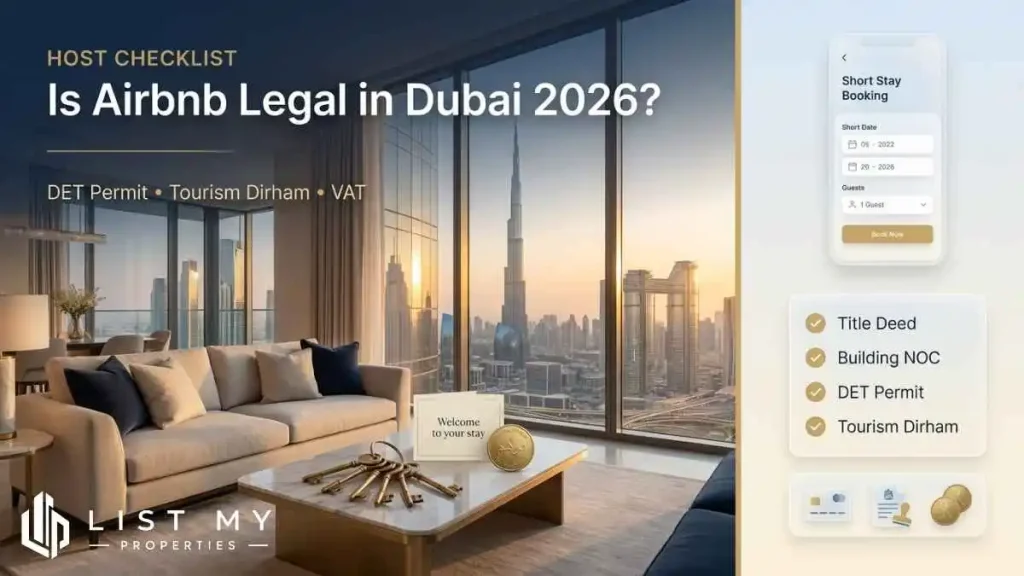
DET’s holiday-home permit pages list documents that may be needed for permit issuance. These can include title deed or approved Dubai Land Department sale purchase agreement, developer NOC if applicable, signed passport copy or Emirates ID of the landlord, company trade licence if the landlord is a company, authorised signatory ID, property management letter and current DEWA bill.
Owners should also confirm whether the building requires additional approval. A unit can be attractive for tourists but still unsuitable if the tower or community restricts short-term guests.
Step-by-Step: How to List Legally
First, check building and developer rules before furnishing the unit.
Second, gather ownership and property documents, including title deed or approved DLD sale agreement, DEWA bill and owner ID.
Third, confirm whether a developer NOC or property management letter is required.
Fourth, apply through the DET holiday-home process and complete classification.
Fifth, display the permit in the unit and prepare guest check-in, cleaning, maintenance and emergency support.
Sixth, list on Airbnb or another platform only after permit readiness.
Seventh, keep records for Tourism Dirham, guest stays, invoices, maintenance and taxes.
Documents Checklist
| Document | Required for |
|---|---|
| Title deed / approved DLD sale agreement | All owners |
| Emirates ID | UAE residents |
| Passport copy | Non-residents |
| Recent DEWA bill | All applicants |
| Ejari certificate | All applicants |
| Developer NOC / management letter | If required by building |
| Landlord NOC | Tenants subletting |
Tourism Dirham and Airbnb Guests
Tourism Dirham is a guest charge linked to hotel and holiday-home accommodation. DET operator registration information shows AED 15 per room per night for Deluxe Holiday Home and AED 10 per room per night for Standard Holiday Home.
Hosts should make sure this is handled clearly in pricing and records. It should not be confused with rent, cleaning fee or platform service fee.
VAT and Tax Risk
Some Airbnb hosts treat short-term rental income like casual rental income, but it can become a tax and accounting issue. The Federal Tax Authority states that VAT registration is mandatory when taxable supplies and imports exceed AED 375,000, and voluntary registration may be possible above AED 187,500.
A single small property may not automatically cross the threshold, but owners with multiple units, company structures or professional operations should get UAE tax advice. VAT, Corporate Tax, invoices and platform income records should be reviewed before scaling.
📌 Keep in mind: Short-term rental income is treated very differently from a long-term Ejari lease for tax and VAT purposes. Don’t assume “rental income is tax-free” applies the same way once you run a hospitality operation.
Building Rules and Guest Problems
Even when the permit route exists, the building can create practical problems. Guest access cards, parking, security registration, noise complaints, pool/gym rules, luggage handling and check-in times can all affect guest reviews and compliance.
Before buying for Airbnb income, ask the broker or building management whether short-term rental is accepted. Do not buy only because the area has tourist demand.
Airbnb vs Long-Term Rent
| Factor | Airbnb / Short-Term | Long-Term Rent |
| Income | Can be higher in peak months | More predictable |
| Workload | High | Lower |
| Compliance | DET holiday-home permit | Ejari tenancy |
| Costs | Furnishing, cleaning, platform, utilities | Usually lower operating cost |
| Vacancy | Seasonal | Usually steadier |
| Best for | Tourism/prime locations | Stable cash flow |
Airbnb is not always more profitable. Net income after cleaning, operator fees, platform fees, utilities, furnishing, repairs and vacancy matters more than nightly rate.
Common Mistakes Hosts Make
The first mistake is listing before permit readiness. The second is assuming landlord ownership means building approval. The third is ignoring Tourism Dirham and tax records.
The fourth mistake is allowing guests before the unit is professionally furnished and photographed. The fifth is comparing gross Airbnb revenue against long-term rent without subtracting operating costs. The sixth is tenants subletting without written landlord permission.
Host Checklist Before Listing
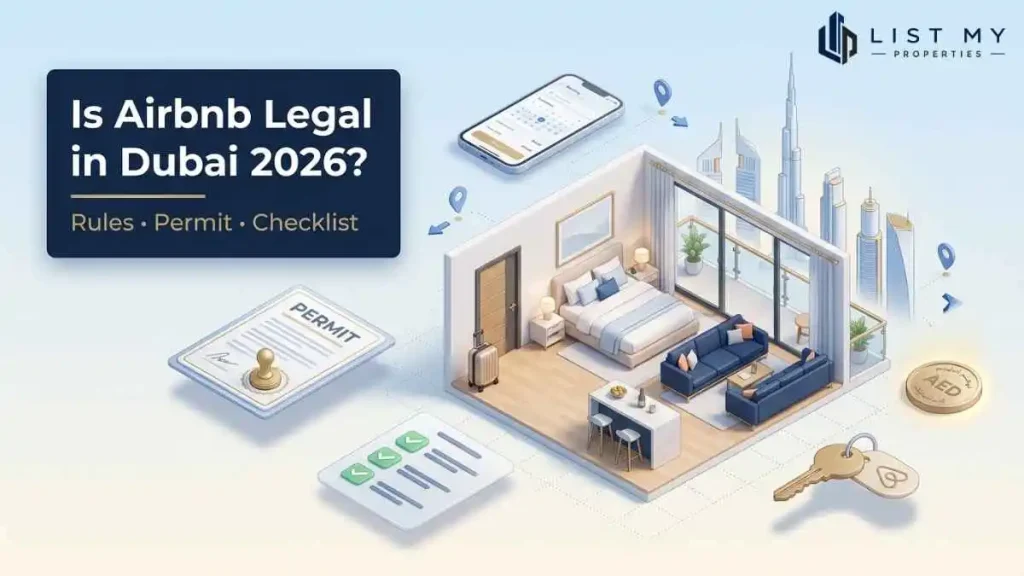
Before listing a Dubai property on Airbnb, check:
- Is the property owner or tenant authorised to host?
- Does the building allow short-term guests?
- Is the title deed or approved DLD sale agreement available?
- Is a developer NOC required?
- Is the DEWA bill ready?
- Has the DET permit route been completed?
- Is the unit classified correctly?
- Is Tourism Dirham handled correctly?
- Is VAT registration needed?
- Are cleaning, guest support and check-in ready?
- Is the permit displayed in the unit?
- Are prices based on net profit, not only nightly rate?
Trusted External Sources
- Dubai DET — Apply for a Holiday Home Permit
Use this for the official holiday-home permit route and permit display requirement. - Dubai DET — New Holiday Homes Permit Issuance
Use this for title deed, approved DLD sale agreement, NOC, owner ID, property management letter and DEWA bill requirements. - Dubai DET — Register as a Holiday Home Operator
Use this for operator registration and Tourism Dirham rates. - Dubai DET — Holiday Homes Regulation Guide
Use this for holiday-home regulation framework and operating guidance. - Federal Tax Authority — VAT Registration
Use this for VAT mandatory and voluntary registration thresholds. - Airbnb — Responsible Hosting in Dubai
Use this as Airbnb’s platform-level reminder that hosts should understand local rules and responsibilities.
FAQ Section
Is Airbnb legal in Dubai in 2026?
Yes, Airbnb can be legal in Dubai when the property is operated under the correct DET holiday-home permit framework and building rules are followed.
Do I need a permit to host Airbnb in Dubai?
Yes. Short-term holiday-home operation normally requires the correct DET permit before accepting guests or listing publicly.
Can tenants Airbnb their rented apartment in Dubai?
Tenants should not sublet on Airbnb without written landlord permission, building compliance and the correct permit route.
Is Airbnb the same as a holiday home in Dubai?
Airbnb is a platform. Holiday home is the regulated accommodation category. The unit needs holiday-home compliance even if bookings come from another platform.
What documents are needed for Airbnb in Dubai?
Documents may include title deed or approved DLD sale agreement, developer NOC if applicable, owner ID, property management letter and current DEWA bill.
Does Airbnb income in Dubai need VAT registration?
VAT registration may be required if taxable supplies and imports exceed AED 375,000. Larger operators and company-owned units should get tax advice.
What is Tourism Dirham for Airbnb in Dubai?
Tourism Dirham is a guest charge linked to accommodation. DET shows AED 15 per room per night for Deluxe holiday homes and AED 10 for Standard holiday homes.
Can every Dubai building be used for Airbnb?
No. Building rules, developer restrictions, guest access and owner association policies can restrict or complicate short-term rental.
Is Airbnb more profitable than long-term rent in Dubai?
It can be, but only after subtracting cleaning, platform fees, management, utilities, furnishing, repairs, vacancy and compliance costs.
What should I check before listing on Airbnb?
Check ownership authority, building approval, DET permit, NOC, DEWA bill, Tourism Dirham, VAT exposure, guest support and net-income forecast.
Yes, Airbnb can be legal in Dubai when the property is operated under the correct DET holiday-home permit framework and building rules are followed.
Yes. Short-term holiday-home operation normally requires the correct DET permit before accepting guests or listing publicly.
Tenants should not sublet on Airbnb without written landlord permission, building compliance and the correct permit route.
Airbnb is a platform. Holiday home is the regulated accommodation category. The unit needs holiday-home compliance even if bookings come from another platform.
Documents may include title deed or approved DLD sale agreement, developer NOC if applicable, owner ID, property management letter and current DEWA bill.
VAT registration may be required if taxable supplies and imports exceed AED 375,000. Larger operators and company-owned units should get tax advice.
Tourism Dirham is a guest charge linked to accommodation. DET shows AED 15 per room per night for Deluxe holiday homes and AED 10 for Standard holiday homes.
No. Building rules, developer restrictions, guest access and owner association policies can restrict or complicate short-term rental.
It can be, but only after subtracting cleaning, platform fees, management, utilities, furnishing, repairs, vacancy and compliance costs.
Check ownership authority, building approval, DET permit, NOC, DEWA bill, Tourism Dirham, VAT exposure, guest support and net-income forecast.
Conclusion
Airbnb is legal in Dubai only when the host follows the correct holiday-home compliance route. The opportunity is real, but so is the compliance risk. Owners should not list first and fix paperwork later.
The safest approach is to confirm building approval, prepare documents, obtain the correct permit, handle Tourism Dirham properly and calculate net income after all operating costs. Tenants should be especially careful because subletting without permission can create serious disputes.
For investors, Airbnb should be compared against long-term rent using net return, not gross nightly revenue. The best short-term rental is compliant, guest-ready and financially realistic.
Key Takeaways
- Airbnb is legal in Dubai when operated through the correct holiday-home framework.
- A DET permit is usually required before hosting.
- Tenants need written landlord permission and proper compliance.
- Tourism Dirham, VAT and guest records should not be ignored.
- Building approval is just as important as platform demand.
- Net profit matters more than nightly rate.
Disclaimer: This article is for general informational purposes only and is not legal, tax, licensing or financial advice. Dubai Airbnb rules, DET requirements, Tourism Dirham, VAT thresholds and building policies can change. Hosts should verify details with DET, FTA, building management, landlord and qualified advisers before listing.
Leave a Reply