

18/06/2026
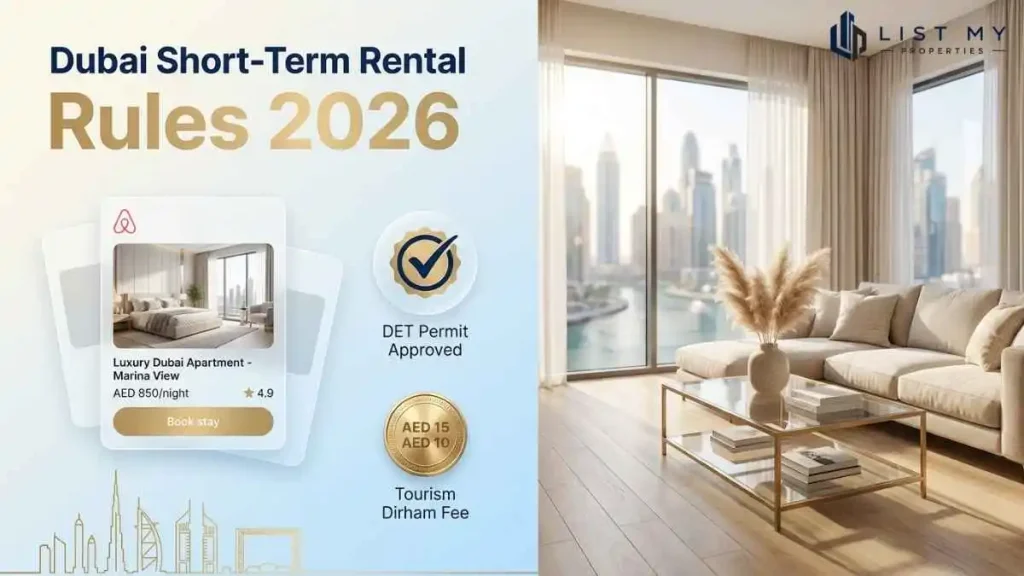
Dubai Short-Term Rental Rules 2026
By Md Arshad
Dubai Rental GuideLast updated 19/06/2026

Dubai Short-Term Rental Rules 2026: DET Permit, Airbnb Rules, Tourism Dirham and Owner Checklist
Featured Snippet Overview: Dubai short-term rentals are regulated as holiday homes by the Dubai Department of Economy and Tourism. Owners or operators should register through the Holiday Homes portal, obtain a permit for the residential unit, classify the property, follow guest and safety rules, collect Tourism Dirham where applicable and keep documents ready. A normal long-term Ejari lease is not the same as a licensed holiday-home operation.
AI Overview Answer: To legally run a short-term rental in Dubai in 2026, the owner or operator should use the DET holiday-home permit route before accepting guests. The property must be documented, furnished, compliant with building rules and listed with accurate permit details. Owners should also check Tourism Dirham, VAT threshold, cleaning, guest registration, insurance, building NOC, platform rules and whether self-management or a licensed operator is safer.
TL;DR
- Short-term rentals in Dubai normally fall under the holiday-home framework regulated by DET.
- A short-term rental is not the same as a standard annual tenancy registered through Ejari.
- Owners/operators should obtain the correct holiday-home permit before listing on Airbnb, Booking.com or similar platforms.
- DET permit documents can include title deed or approved DLD sale purchase agreement, developer NOC if applicable, landlord ID, DEWA bill and property management letter where relevant.
- DET operator registration shows a fixed registration charge of AED 1,520 and Tourism Dirham rates of AED 15 per room per night for Deluxe and AED 10 for Standard holiday homes.
- Homeowners should check the unit, building rules, owner association restrictions, furnishing standards, safety requirements and tax/VAT exposure.
- VAT registration may become mandatory when taxable supplies/imports exceed AED 375,000.
- The safest route is: check property eligibility, register/permit correctly, keep guest records, collect applicable fees and renew on time.
Table of Contents
Dubai Short-Term Rental Readiness and Profit Calculator
Estimate short-let revenue, compare it with long-term rent after real costs, and get a compliance readiness score. Planning tool only, not legal or tax advice.
Annual gross revenue
-
Monthly short-let revenue
-
Annual operating cost
-
Net short-let income (yr 1)
-
Long-term rent (for compare)
-
Readiness score
-
Want a detailed short-let plan and compliant operator options? Tell us where to send it.
Talk to a short-let expert on WhatsApp
Estimates only. Tourism Dirham is collected from guests and passed to DET, so it is treated as a pass-through, not a host cost. Actual DET fees, permit eligibility, occupancy, building rules and VAT obligations can change. Verify with DET, FTA, building management and a licensed adviser before listing.
What Counts as a Short-Term Rental in Dubai?
A short-term rental in Dubai usually means a furnished residential unit rented to guests for temporary stays instead of a standard annual tenancy. These properties are commonly marketed on Airbnb, Booking.com, direct booking websites and holiday-home operator platforms.
For compliance, the important term is “holiday home.” Dubai regulates holiday-home activity through DET. If a property is being offered to visitors on a nightly, weekly or flexible short-stay basis, owners should not treat it like a casual private arrangement. It needs the correct permit route and operating controls.
Is Airbnb Legal in Dubai?
Yes, Airbnb-style short-term letting can be legal in Dubai when the property is operated under the correct holiday-home framework. The issue is not the platform itself; the issue is whether the unit is permitted, classified, documented and operated according to DET and building requirements.
Owners should avoid listing first and asking questions later. A listing without the correct permit, owner authority or building approval can create fines, guest disputes, platform removal and problems with the building management.

DET Holiday Home Permit: What Owners Need
The official DET “New Holiday Homes permit issuance” service is for applying to operate a residential unit as a holiday home. Required documents listed by DET include title deed or approved DLD sales purchase agreement, developer NOC if applicable, landlord ID, company trade licence if the landlord is a company, authorised signatory ID, property management letter and current DEWA bill.
DET also notes service requirements such as entering the DEWA premise number during the online application and matching operator permit dates with the property management letter where relevant.
This means owners should prepare documents before advertising the property. The permit should match the actual unit, ownership and management structure.
Owner, Tenant or Operator: Who Can Apply?
There are three common setups.
| Setup | What to Check |
| Owner self-manages | Owner should register and permit correctly, then handle guests and reporting. |
| Licensed operator manages | Operator should have authority from owner and valid holiday-home process. |
| Tenant wants to short-let | Tenant needs written landlord permission and must not breach tenancy/building rules. |
Tenants should be especially careful. Renting a unit annually and then listing it short-term without landlord permission can create tenancy disputes and compliance risk.
Tourism Dirham and Guest Charges
DET’s holiday-home operator registration page lists Tourism Dirham charges from guests based on classification: AED 15 per room per night for Deluxe Holiday Home and AED 10 per room per night for Standard Holiday Home. Owners/operators should keep clear records and make sure guest invoices separate the room rate, cleaning and government charges where applicable.
Tourism Dirham is not the same as rent. It is a guest-related hospitality charge that must be handled correctly by the holiday-home operator or owner.
VAT and Tax Considerations
Short-term rental income can become a tax and accounting topic, especially for owners running multiple units or using a company. The Federal Tax Authority states that VAT registration is mandatory if taxable supplies and imports exceed AED 375,000, and voluntary registration may be available above AED 187,500.
A single owner with one unit may not automatically cross VAT thresholds, but professional operators, multiple-unit owners and company structures should ask a UAE tax adviser to review VAT and Corporate Tax exposure.
Building Rules, NOC and Owner Association Restrictions
A DET permit does not always mean the building will be easy to operate in. Some buildings have short-term rental restrictions, access-card controls, guest registration rules, parking rules, noise complaints, security requirements or owners association conditions.
Before buying a unit for Airbnb income, ask the seller, broker, developer or building management whether holiday-home operation is allowed. A unit with strong nightly demand can still be a poor investment if the building blocks short-term guests.
Short-Term Rental vs Long-Term Rent
| Factor |
| Income potential |
| Workload |
| Compliance |
| Costs |
| Vacancy risk |
| Best for |
| Short-Term Rental |
| Can be higher in peak season |
| High guest turnover, cleaning, reviews |
| DET holiday-home framework |
| Furnishing, cleaning, platform fees, management |
| Seasonal and event-driven |
| Tourism areas, flexible owners |
| Long-Term Lease |
| More predictable |
| Lower day-to-day workload |
| Ejari tenancy route |
| Lower operating cost |
| Usually steadier |
| Stable landlords |
Short-term rental is not always better. It works best when location, furnishing, pricing, operations and compliance are strong.
Common Mistakes Owners Make
The first mistake is listing on Airbnb without checking the permit route. The second is ignoring building rules. The third is assuming gross nightly revenue is profit. Cleaning, furnishing, platform fees, management fees, utilities, repairs and vacancy can reduce returns.
The fourth mistake is underpricing during peak season or overpricing during weak months. The fifth is not keeping guest records, invoices and fee records organised.
Owner Checklist Before Listing
Before listing a Dubai property short-term, check:
- Is the property eligible for holiday-home operation?
- Do I have title deed or approved DLD sale document?
- Do I need developer or building NOC?
- Is DEWA active and document-ready?
- Is the unit fully furnished and guest-ready?
- Have I registered through the correct DET route?
- Have I classified the property correctly?
- Do I understand Tourism Dirham collection?
- Do I need VAT registration or tax review?
- Will I self-manage or use a licensed operator?
- Are house rules, check-in and guest support ready?


Trusted External Sources
- Dubai DET — Apply for a Holiday Home Permit
Use this for the official holiday-home permit route. - Dubai DET — New Holiday Homes Permit Issuance
Use this for documents, NOC, DEWA and property management letter requirements. - Dubai DET — Register as a Holiday Home Operator
Use this for operator registration, registration charge and Tourism Dirham rates. - Dubai DET — Holiday Homes Regulation Guide 2022
Use this for the regulatory framework referencing Decree No. 41 of 2013 and related rules. - Federal Tax Authority — VAT Registration
Use this for VAT registration thresholds. - Property Finder — Holiday Homes Dubai Guide
Use this as a competitor/reference source for holiday-home market explanation.
FAQ Section
Is short-term rental legal in Dubai?
Yes, short-term rental can be legal in Dubai when the property is operated through the correct DET holiday-home permit framework and building rules are followed.
Do I need a permit to list my Dubai property on Airbnb?
Yes. Owners or operators should obtain the correct holiday-home permit before accepting short-term guests or listing the property on platforms.
Is Ejari required for short-term rentals?
Holiday-home operation is different from a standard long-term tenancy. Long-term residential leases use Ejari, while short-term holiday homes follow the DET holiday-home route.
Can a tenant sublet a Dubai apartment on Airbnb?
Only with proper landlord permission, building compliance and the correct permit route. Tenants should not list a rented apartment without written approval.
What documents are needed for a Dubai holiday-home permit?
Documents can include title deed or approved DLD sale purchase agreement, developer NOC if applicable, landlord ID, company licence if relevant, property management letter and current DEWA bill.
What is Tourism Dirham for holiday homes?
Tourism Dirham is a guest charge based on holiday-home classification. DET lists AED 15 per room per night for Deluxe and AED 10 per room per night for Standard holiday homes.
Do short-term rental owners need VAT registration?
VAT registration may be required if taxable supplies/imports exceed AED 375,000. Owners with multiple units or company structures should get tax advice.
Can every Dubai building be used for short-term rental?
No. Owners should check building rules, developer requirements, owner association restrictions and permit eligibility before listing.
Is short-term rental better than long-term rent?
It can produce higher income in strong locations, but it also has higher workload, furnishing, cleaning, platform fees, compliance and vacancy risk.
What should I check before starting short-term rental in Dubai?
Check permit eligibility, NOC, DEWA documents, building rules, furnishing standards, guest process, Tourism Dirham, VAT exposure and management setup.
Conclusion
Dubai short-term rentals can be profitable, but they are not casual side listings. They are regulated holiday-home operations that require the correct DET permit, proper documents, guest-ready furnishing and ongoing compliance.
Owners should compare short-term income against long-term rent after all real costs. A unit in Dubai Marina, Downtown, Business Bay or JVC may look strong on nightly rate, but net performance depends on occupancy, cleaning, management fees, utilities, guest reviews and building rules.
The safest approach is simple: check eligibility first, get the permit, follow DET rules, keep records and only then list the property.
Key Takeaways
- Dubai short-term rentals are regulated through the DET holiday-home framework.
- Owners should not list before checking permit and building rules.
- Tourism Dirham and VAT exposure should be reviewed before operations.
- A licensed operator may be safer for overseas owners.
- Short-term rental income should be compared against long-term rent after costs.
- Compliance, guest experience and building approval are as important as nightly rate.
Disclaimer: This article is for general informational purposes only and is not legal, tax, licensing or financial advice. Dubai short-term rental rules, DET requirements, fees, VAT obligations and building policies can change. Owners should verify details with DET, FTA, building management and qualified advisers before listing.

Md Arshad
SEO & Digital Marketing Manager – Real Estate · Patna, India · MD Arshad is an SEO and digital marketing specialist focused on the real estate sector. He works as Digital Marketing Specialist at Dhruv Iconic Pvt. Ltd., a RERA-registered real estate company in Patna with 1.5+ years in the market, and has spent the last 0.5 years partnering with multiple real estate brands as a freelance SEO and content strategist. His work covers technical SEO, keyword research, competitor gap analysis, content strategy, and organic growth. He writes ListMyProperties guides to turn complex UAE real estate processes into clear, source-backed content, with every legal, tax, or fee claim referenced to official authorities such as DLD, RERA, DET, and the FTA. Connect on LinkedIn.
Leave a Reply