

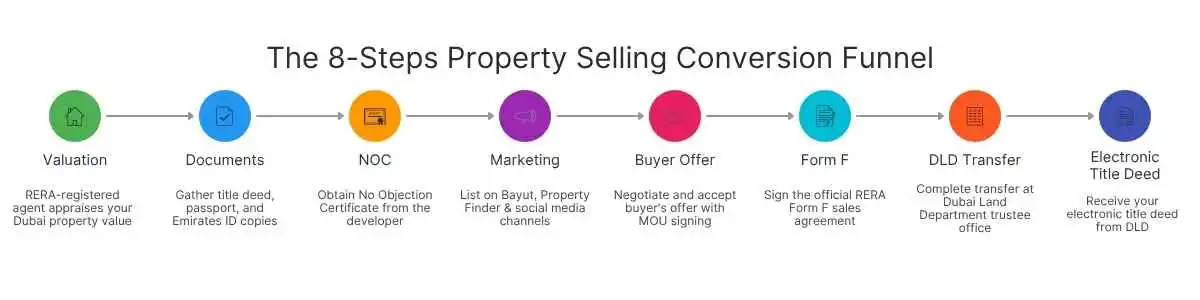
- Selling follows a 10-step funnel: valuation → documents → e-NOC → mortgage check → broker & marketing → listing → buyer screening → offer terms → DLD fees → transfer registration.
- DLD fees: seller 2% + buyer 2% of sale value, plus title deed, map, knowledge and innovation fees.
- Required docs: title deed, Emirates ID/passport, developer e-NOC (freehold, via Dubai REST), Form F, mortgage papers.
- Property Sale Registration at a DLD trustee office takes about 20 minutes once everything is ready.
- Start with a free valuation — the strongest price anchor and lead trigger.
How to Sell Property in Dubai
To sell property in Dubai, get a market valuation, prepare your title deed and Emirates ID or passport, obtain the developer e-NOC, settle any mortgage, appoint a licensed broker, market and screen buyers, agree terms, then complete Property Sale Registration at a DLD trustee office — usually about 20 minutes.
Selling property in Dubai can be profitable, but it can also become stressful if the seller starts without a clear process. Many owners begin by asking an agent to “just list it,” but that is usually not enough. A successful sale needs proper valuation, clean documents, legal readiness, buyer-focused marketing, and smooth transfer coordination.
This guide explains the complete Dubai property selling funnel in 2026. It is written for property owners, landlords, investors, non-resident owners, apartment sellers, villa sellers, and anyone asking, “How do I sell my property in Dubai without delays?”
Quick Answers
What documents are needed to sell property in Dubai? DLD lists Emirates ID or passport for seller and buyer, plus a developer e-NOC in freehold areas via the Dubai REST App.
What are DLD fees when selling? Seller 2% and buyer 2% of sale value, plus title deed, map, knowledge, innovation and service-partner fees.
Do I need a valuation before selling? Strongly recommended — DLD also offers an official property valuation service for units, villas, land and more.
How long does sale registration take? DLD lists about 20 minutes once documents, parties, approvals and payment are ready.
Key Facts box
- Process: 10-step seller funnel
- DLD fee: 2% seller + 2% buyer (+ extras) — Source: DLD
- Sale registration time: ~20 minutes
- Schema: FAQPage + HowTo (10 steps) + speakable.
Table of Contents
Why Sellers Need a Funnel, Not Just a Listing
A property listing is only one part of the sale. A seller needs a funnel that takes the property from “thinking of selling” to “ready for transfer.” Without this structure, the property may attract low-quality enquiries, wrong buyer expectations, delayed offers, or transfer-stage problems.
A proper Dubai seller funnel should answer five questions. What is the property worth? Is it legally ready to sell? How will it be marketed? Are buyers serious and qualified? Can the sale complete through DLD without delay?
Dubai Land Department’s property sale registration process involves document submission at a Real Estate Registration Trustee office, transaction data entry, fee payment, and output sent by email. This means the final transfer depends on preparation before that stage.
Step 1: Start With a Free Property Valuation
The first step in the funnel is valuation. A seller should not list property based only on emotion, old market memory, or what another owner is asking. The property value depends on location, building, size, view, floor, layout, condition, tenancy status, service charges, recent transactions, and buyer demand.
Dubai Land Department provides an official Property Valuation service for different property types, including vacant land, residential units, villas, commercial and industrial buildings, villa compounds, labor accommodations, and hotel buildings.
For a seller funnel, the website should place a Free Property Valuation CTA near the top of the page. This is the strongest lead capture point because the seller is already thinking about price. The CTA should not say “Contact us” only. It should say something specific like “Get My Free Dubai Property Valuation.”
Step 2: Prepare Seller Documents Before Marketing
The second step is document readiness. A seller who prepares documents early looks more professional and avoids delay when a serious buyer appears. The core documents may include title deed, Emirates ID or valid passport, e-NOC requirement, Form F, mortgage documents, Ejari or tenancy details, service charge status, and Power of Attorney if a representative is involved.
Dubai Land Department lists Emirates ID of both seller and buyer for identity verification, or valid passport for non-resident foreigners, as required documents for individual property sale registration. It also lists a no-objection e-certificate from the developer in freehold areas via Dubai REST App.
This section should link to the detailed document checklist page. That supporting article helps build topical authority and keeps users moving inside the website.
Property Net Proceeds Calculator
See how much you actually keep after DLD fees, agency commission and mortgage settlement.
Get my free property valuation
Our Dubai sales team will confirm your realistic sale price and exact net proceeds.
Step 3: Check e-NOC and Developer Clearance
The e-NOC is one of the most important transfer-stage items for many Dubai sellers. It helps confirm that the developer has no objection to the property transfer. If service charges, developer dues, or property records are not clear, transfer can slow down.
DLD’s Property Sale Registration page lists the no-objection e-certificate from the developer in freehold areas through Dubai REST App as a required document.
Dubai REST is DLD’s smart real estate platform for property owners, tenants, brokers, developers, valuators, investors, and other real estate market users. DLD says property owners can access property information such as current prices, rental return, and service charges through the real estate wallet.
Step 4: Handle Mortgage Status Early
If the property is mortgaged, the seller should not wait until the last moment. A mortgaged property sale may involve bank liability letters, manager cheques, mortgage release, and extra coordination.
DLD states that registering the sale of a mortgaged property allows the transaction to reserve rights between parties and complete the sale after submitting a mortgage release letter from the bank.
DLD lists required documents for mortgaged property sale including a liability letter from the bank or developer, UAE ID or valid passport, three manager cheques, and legal Power of Attorney if someone acts on behalf of a party.
Mortgaged Property Seller?
Check bank liability letter, manager cheque requirements, and mortgage release steps before accepting a final offer.
Step 5: Choose a Licensed Broker and Marketing Strategy
The broker should not only upload the property to portals. A proper selling agent should help with valuation, positioning, documentation, listing quality, buyer screening, offer handling, and transfer support.
A good marketing strategy includes professional photos, accurate listing copy, portal exposure, buyer database outreach, WhatsApp lead handling, retargeting, social media, website landing pages, and area-specific SEO pages.
For real estate advertising, DLD’s Real Estate Ad Permit service covers multiple advertisement types, including electronic advertisements, classified advertisements, open house events, promotional campaigns, real estate promotion platforms, and other formats.
DLD also lists the process for a real estate ad permit: login to Tarakhesi, select service, fill required information, upload documents, employee review, payment, and receipt of e-permit certificate.
Step 6: Build a Buyer-Focused Listing
A weak listing says “luxury property, best deal, call now.” A strong listing answers buyer questions before the buyer asks them.
A seller’s listing should include property type, community, building, unit size, bedroom count, view, floor, furnishing status, tenancy status, service charges, upgrades, price logic, parking, amenities, viewing availability, and transfer readiness.
For SEO, the website should also create area-focused pages such as “Sell Property in Dubai Marina,” “Sell Apartment in Business Bay,” “Sell Villa in Dubai Hills,” and “Sell Property in JVC.” These pages capture long-tail local seller intent and support topical authority.
Step 7: Screen Buyers Before Viewings
Not every enquiry is worth a viewing. Some buyers are only browsing. Some are not finance-ready. Some are comparing unrealistic prices. Screening saves time for the seller and helps focus on serious buyers.
A seller or agent should ask whether the buyer is cash or mortgage-backed, whether they have viewed similar properties, what their timeline is, whether they understand DLD fees, and whether they are buying for investment or personal use.
This is also where the seller funnel becomes stronger than a simple listing. The website can educate buyers and sellers before the first call, reducing low-quality enquiries.
Step 8: Negotiate Offers With Clear Terms
A good offer is not only about price. It also includes deposit, transfer timeline, mortgage status, buyer readiness, NOC timing, furniture inclusion, tenancy handover, service charge responsibility, and fee responsibility.
The seller should avoid vague agreements. Every serious offer should move toward written terms so both sides understand the transaction.
This page should internally link to Form F because the seller must understand how agreed terms move into sale documentation.


Step 9: Understand DLD Fees Before Transfer
Before the transfer stage, both buyer and seller should understand the cost structure. DLD lists seller fee as 2% of sale value and buyer fee as 2% of sale value for property sale registration. DLD also lists additional fees such as title deed certificate issuance, map fees, knowledge fee, innovation fee, and service partner fees.
This is a conversion opportunity. Add a DLD cost explanation block and link to the full DLD transfer fee guide.
Step 10: Complete Property Sale Registration
When the seller and buyer are ready, the transaction moves to the official transfer stage. DLD explains that at the service center, parties submit required documents at the Real Estate Registration Trustee office, the employee verifies documents, transaction data is entered, fees are paid, and the output is sent by email.
DLD lists the service time for Property Sale Registration as 20 minutes, but this should not be confused with the full selling timeline. The official processing can be fast when all preparation is complete. The full sales journey includes valuation, documents, marketing, buyer negotiation, NOC, mortgage steps if applicable, and transfer coordination.
Check Your Property Selling Readiness
Tick the steps you have completed and see how ready your Dubai property is for a smooth sale.
Start checking your selling readiness
Your readiness score will update as you tick each item.
FAQ Section
How do I sell my property in Dubai?
Start with a property valuation, prepare title deed and identity documents, check e-NOC requirements, appoint a broker, list and market the property, screen buyers, agree terms, prepare sale documents, and complete transfer through DLD or a Real Estate Registration Trustee office.
What documents are needed to sell property in Dubai?
For standard sale registration, DLD lists Emirates ID for seller and buyer identity verification, or valid passport for non-resident foreigners, plus developer e-NOC in freehold areas through Dubai REST App.
Do I need a valuation before selling?
A valuation is strongly recommended because it helps set a realistic asking price. DLD also provides a property valuation service for residential units, villas, land, commercial buildings, and other property types.
Do I need an advertising permit to market property in Dubai?
DLD’s Real Estate Ad Permit service covers electronic advertisements, classified advertisements, open house events, promotional campaigns, real estate promotion platforms, and other advertising formats.
What are DLD fees when selling property?
DLD lists standard property sale registration fees as seller 2% and buyer 2% of sale value, plus additional title deed, map, knowledge, innovation, and service partner fees.
Conclusion
Selling property in Dubai works best when the seller follows a clear funnel. The process should begin with valuation, then move through document readiness, e-NOC checks, mortgage review, compliant marketing, buyer screening, offer negotiation, DLD fee planning, and final transfer registration. A seller who prepares these steps early can reduce delays, improve buyer trust, and move toward a cleaner sale.
Key Takeaways
- Start with a realistic Dubai property valuation.
- Prepare title deed, Emirates ID or passport, e-NOC, tenancy, and mortgage documents early.
- Check Dubai REST App and developer clearance before transfer pressure begins.
- Use compliant property advertising and a clear broker-led marketing strategy.
- Screen buyers before wasting time on viewings.
- Understand DLD fees before signing final sale terms.
- Use the Seller Funnel Tool inside the page to increase engagement and lead conversion.
- Link this page to valuation, documents, NOC, Form F, and DLD fee guides for topical authority.

Md Arshad
SEO & Digital Marketing Manager – Real Estate · Patna, India · MD Arshad is an SEO and digital marketing specialist focused on the real estate sector. He works as Digital Marketing Specialist at Dhruv Iconic Pvt. Ltd., a RERA-registered real estate company in Patna with 1.5+ years in the market, and has spent the last 0.5 years partnering with multiple real estate brands as a freelance SEO and content strategist. His work covers technical SEO, keyword research, competitor gap analysis, content strategy, and organic growth. He writes ListMyProperties guides to turn complex UAE real estate processes into clear, source-backed content, with every legal, tax, or fee claim referenced to official authorities such as DLD, RERA, DET, and the FTA. Connect on LinkedIn.