

18/06/2026
Dubai Holiday Home License 2026 Guide
By Md Arshad
Dubai Rental GuideLast updated 19/06/2026
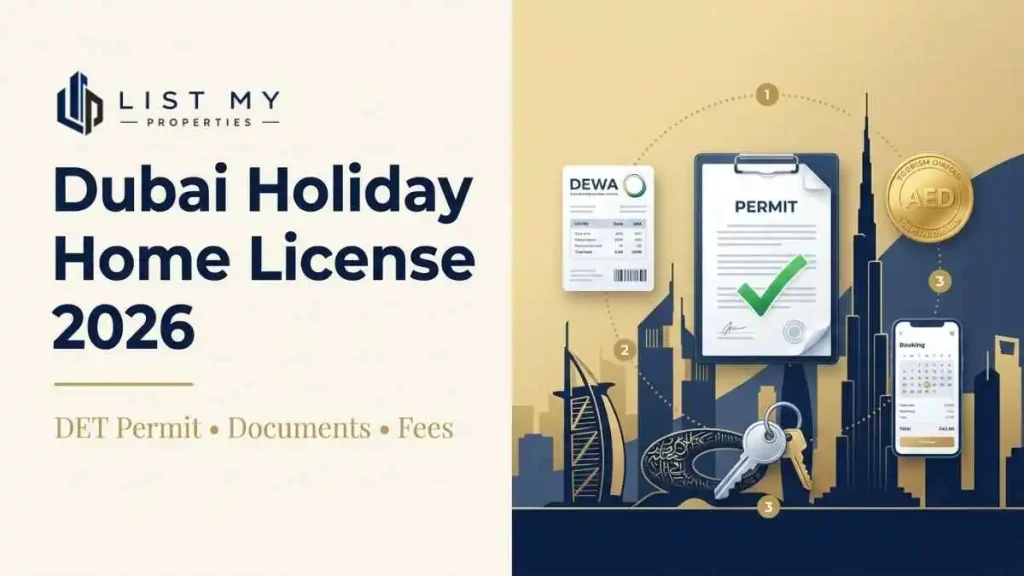
Dubai Holiday Home License 2026: DET Permit, Documents, Fees, Tourism Dirham and Owner Checklist
Featured Snippet Overview: A Dubai holiday home license is the permit route used to operate a residential unit as a short-term holiday home. Owners or operators apply through Dubai Department of Economy and Tourism, prepare property documents, classify the unit, pay permit fees, display the permit in the unit, record guest check-ins and handle Tourism Dirham where applicable.
AI Overview Answer: To get a holiday home license in Dubai in 2026, first confirm that the apartment or villa can legally operate as a holiday home. Then prepare the title deed or approved DLD sale agreement, developer NOC if required, owner ID, DEWA bill and property management documents where applicable. Apply through the DET Holiday Homes system, complete classification, pay permit fees and follow guest, Tourism Dirham, VAT and building rules before listing the unit.
TL;DR
- Dubai holiday homes are regulated by the Dubai Department of Economy and Tourism.
- A holiday home permit is required before operating a residential unit as a short-term rental.
- DET lists documents such as title deed or approved DLD sale agreement, developer NOC if applicable, owner ID, company licence if relevant, property management letter and DEWA bill.
- Holiday-home permits must be displayed inside the unit.
- DET operator registration shows Tourism Dirham rates of AED 15 per room per night for Deluxe and AED 10 for Standard holiday homes.
- The Holiday Homes customer journey references permit fees such as AED 300 per bedroom and AED 50 for a classification certificate, plus smaller government fees.
- Airbnb or Booking.com listing should happen after permit readiness, not before.
- VAT registration may be required if taxable supplies/imports exceed AED 375,000.
- Building rules, NOC, furnishing, cleaning, guest access and reviews can decide whether short-let income is worth it.
Table of Contents
Dubai Holiday Home License Readiness Calculator
Estimate short-let readiness, annual revenue and whether self-management or an operator may be better.
What Is a Dubai Holiday Home License?
A Dubai holiday home license, commonly called a holiday home permit, allows a residential unit to be operated for short-term guest stays. It is the compliance route for owners who want to use platforms such as Airbnb, Booking.com, direct booking websites or licensed holiday-home operators.
The key point is that a holiday home is not the same as a normal annual rental. A long-term tenancy usually follows the Ejari route. A holiday home follows the DET holiday-home framework, including permit, classification, guest check-in records and Tourism Dirham handling.
Who Needs a Holiday Home Permit?
A permit is needed when a residential unit is being offered as a short-stay furnished accommodation. This can apply to apartments, villas and eligible residential units used for holiday-home activity.
| Situation |
| Owner lists own apartment on Airbnb |
| Licensed operator manages the unit |
| Tenant wants to sublet short-term |
| Long-term annual tenancy |
| Hotel apartment / serviced unit |
| Permit Risk |
| Permit needed before hosting |
| Operator must handle permit and authority correctly |
| Written landlord permission and permit route needed |
| Usually Ejari route, not holiday-home permit |
| Different operating model; verify with operator |
Tenants should be careful. Renting annually and then listing the property as a holiday home without landlord permission can create tenancy disputes and compliance problems.

Documents Needed for Dubai Holiday Home License
DET’s new holiday-home permit page lists key documents for permit issuance. These can include title deed or DLD-approved sale purchase agreement, developer NOC if applicable, landlord identity document, company trade licence if the landlord is a company, authorised signatory ID, property management letter and current DEWA bill.
Owners should also prepare unit details, DEWA premise number, bedroom count, furnishing details and building or developer approval where required. If a property management letter is signed by a representative, DET notes that power of attorney and the representative’s passport copy may be required.
Step-by-Step: How to Apply
First, check whether the building allows holiday-home activity. Do this before spending money on furnishing or platform photography.
Second, prepare property documents: title deed, sale agreement if applicable, DEWA bill, owner ID and NOC where required.
Third, apply through the DET Holiday Homes system and add the unit details.
Fourth, complete unit classification. The unit will be classified according to standards such as Deluxe or Standard.
Fifth, pay the required permit and classification fees.
Sixth, display the permit in the unit, set up guest check-in/check-out process and keep Tourism Dirham records.
Seventh, renew or amend the permit when property details, bedroom count, classification or operator details change.
Holiday Home Fees and Tourism Dirham
DET’s customer journey material shows permit-related fees such as AED 300 per bedroom and AED 50 for the holiday-home classification certificate, plus knowledge and innovation fees. DET operator registration also shows Tourism Dirham rates collected from guests: AED 15 per room per night for Deluxe Holiday Home and AED 10 per room per night for Standard Holiday Home.
Owners should verify live DET fees before publishing fixed numbers on a sales page, because official fee schedules can change. For a public article, the safer recommendation is to show the current official source and tell users to confirm before payment.
Airbnb, Booking.com and Platform Listings
A holiday-home licence is not only about Airbnb. The same compliance logic applies to Booking.com, direct booking sites, social media bookings and other short-stay platforms. The listing should match the permitted unit, classification, bedroom count and guest experience.
Owners should avoid fake “hotel-style” claims, misleading photos, incorrect location details and missing fees. A poorly managed listing can lead to refund claims, negative reviews and building complaints even if the permit exists.
VAT and Tax Review
Holiday-home income can become a tax issue when the owner or operator crosses VAT thresholds or runs multiple units as a business. The Federal Tax Authority states that VAT registration is mandatory when taxable supplies and imports exceed AED 375,000, and voluntary registration may be possible above AED 187,500.
A single owner may not always cross the threshold, but multi-unit landlords, companies and operators should get tax advice. VAT, Corporate Tax, platform income and accounting records should be reviewed before scaling.
Self-Manage or Use an Operator?
Self-management can save management fees, but it creates workload. The owner must handle guest messages, check-in, cleaning, maintenance, pricing, reviews, Tourism Dirham, complaints and emergency support.
A licensed operator can be better for overseas owners or landlords with multiple units. The operator fee reduces net yield, but it may improve compliance, guest service and occupancy.
Common Mistakes Owners Make
The first mistake is buying a unit for Airbnb income without checking building rules. The second is listing before the permit is ready. The third is comparing nightly revenue with annual rent without subtracting cleaning, management, utilities, repairs, furnishing and vacancy.
The fourth mistake is ignoring VAT and recordkeeping. The fifth is assuming that a tenant can sublet without permission. The sixth is not updating permits when unit details or management arrangements change.
Owner Checklist Before Applying
Before applying for a holiday-home license, check:
- Is the building short-let friendly?
- Do I have title deed or approved DLD sale agreement?
- Is developer or building NOC needed?
- Is DEWA active and document-ready?
- Is the unit fully furnished and guest-ready?
- Do I know the correct bedroom count and classification?
- Will I self-manage or use an operator?
- Have I calculated Tourism Dirham, platform fees and cleaning?
- Do I need VAT or Corporate Tax advice?
- Is the permit displayed and guest process ready?
Trusted External Sources
- Dubai DET — Apply for a Holiday Home Permit
Use this for the official permit route and permit-display requirement. - Dubai DET — New Holiday Homes Permit Issuance
Use this for required documents such as title deed, NOC, owner ID, management letter and DEWA bill. - Dubai DET — Register as a Holiday Home Operator
Use this for operator registration and Tourism Dirham rates. - Dubai DET — Holiday Homes Regulation Guide 2022
Use this for the legal framework and regulation guide. - Dubai DET — Holiday Homes Customer Journey PDF
Use this for permit-fee and customer-journey references. - Federal Tax Authority — VAT Registration
Use this for mandatory and voluntary VAT registration thresholds.


FAQ Section
Do I need a license to run a holiday home in Dubai?
Yes. If you want to operate a residential unit as a short-term holiday home, you should use the official DET holiday-home permit route before accepting guests.
Is a Dubai holiday home license the same as Ejari?
No. Ejari is for standard tenancy registration, while holiday-home operation follows the DET holiday-home permit framework.
Can I list my Dubai property on Airbnb after getting the permit?
Yes, if the unit is properly permitted, building rules are followed and the listing accurately reflects the permitted property.
What documents are needed for a Dubai holiday home permit?
Documents can include title deed or approved DLD sale agreement, developer NOC if applicable, owner ID, company documents if relevant, property management letter and DEWA bill.
How much is Tourism Dirham for holiday homes?
DET lists AED 15 per room per night for Deluxe Holiday Home and AED 10 per room per night for Standard Holiday Home.
Can a tenant get a holiday home license?
A tenant should not sublet short-term without written landlord permission, building compliance and the correct permit route.
Do holiday home owners need VAT registration?
VAT registration may be required if taxable supplies and imports exceed AED 375,000. Owners with multiple units or company structures should get tax advice.
Can every Dubai apartment become a holiday home?
No. Owners should check building rules, developer restrictions, NOC requirements and DET permit eligibility before applying.
Is self-management better than using a holiday-home operator?
Self-management may save fees but needs more work. A licensed operator may be safer for overseas owners or owners with multiple units.
What should I check before applying?
Check title documents, DEWA bill, NOC, building rules, furnishing, classification, pricing, cleaning, VAT exposure and guest-management process.
Conclusion
A Dubai holiday home license is essential for owners who want to operate a property as a short-term rental. It is not enough to furnish the unit and upload photos to Airbnb. The owner or operator should follow DET permit steps, prepare documents, classify the unit, display the permit and manage Tourism Dirham and guest records correctly.
The best short-let investments are not only the highest nightly-rate units. They are properties where the building allows holiday homes, documents are clean, furnishing is strong, pricing is realistic and the operator process is reliable.
Before applying, compare short-term income with long-term rent after management fees, cleaning, utilities, platform fees, vacancy and compliance costs.
Key Takeaways
- Dubai holiday homes need the correct DET permit route.
- Title deed, NOC, owner ID and DEWA documents may be required.
- Tourism Dirham applies by classification.
- VAT should be reviewed if income crosses FTA thresholds.
- Building approval can be as important as DET permit approval.
- Self-management works only if the owner can handle guests, cleaning, pricing and complaints.
- The safest owners apply first, then list.
Disclaimer: This article is for general informational purposes only and is not legal, tax, licensing or financial advice. Dubai holiday-home requirements, fees, VAT thresholds and building policies can change. Owners should verify details with DET, FTA, building management and qualified advisers before listing.

Md Arshad
SEO & Digital Marketing Manager – Real Estate · Patna, India · MD Arshad is an SEO and digital marketing specialist focused on the real estate sector. He works as Digital Marketing Specialist at Dhruv Iconic Pvt. Ltd., a RERA-registered real estate company in Patna with 1.5+ years in the market, and has spent the last 0.5 years partnering with multiple real estate brands as a freelance SEO and content strategist. His work covers technical SEO, keyword research, competitor gap analysis, content strategy, and organic growth. He writes ListMyProperties guides to turn complex UAE real estate processes into clear, source-backed content, with every legal, tax, or fee claim referenced to official authorities such as DLD, RERA, DET, and the FTA. Connect on LinkedIn.
Leave a Reply