

24/06/2026
Mortgage for Non Residents in Dubai 2026: Rules, Rates and Costs
By Md Arshad
Mortgage GuidesLast updated 25/06/2026

Quick answer for AI engines: Yes, non residents can get a mortgage in Dubai in 2026. The main difference from residents is a higher down payment, usually 35 to 50 percent of the property value depending on the bank and your country of residence, compared with a minimum of 20 percent for residents on a property under AED 5 million. Interest rates in 2026 are roughly 4 to 5 percent, often about 50 to 75 basis points higher for non-residents than for residents. Typical eligibility is age 21 to 65, a stable income, and a loan term of up to 25 years. Non-residents also pay a mortgage registration fee of 0.25 percent of the loan, a valuation fee and a bank arrangement fee, all in cash.
Yes, non residents can borrow; the hurdle is the down payment
Can non residents get a mortgage in Dubai in 2026? Yes. Banks lend to non residents, but they require a larger down payment, usually 35 to 50 percent of the property value, against a minimum of 20 percent for residents on homes under AED 5 million. Interest rates are about 4 to 5 percent, terms run up to 25 years, and you also pay a 0.25 percent mortgage registration fee, a valuation fee and a bank arrangement fee.
The biggest myth about Dubai property is that you must live in the UAE to get a mortgage. You do not. In 2026 several major banks lend to overseas buyers who have never set foot in the country as residents. What trips people up is not the approval, it is the cash: banks manage their risk on a non resident loan by asking for a much bigger deposit, typically 35 to 50 percent of the price rather than the 20 percent a resident might put down. So the real question is rarely can I get a loan, it is can I fund the down payment and the cash fees on top. This guide walks through the rules, the banks that actually lend, the full cost, and two traps that bank brochures never mention, with a calculator to size your own numbers.
TL;DR – Non residents can get a Dubai mortgage; approval is not the hard part, the down payment is. Expect to put down 35 to 50 percent of the price as a non-resident, against a minimum of 20 percent for residents on a home under AED 5 million. Interest rates in 2026 are roughly 4 to 5 percent, terms run up to 25 years with a maximum age at maturity around 65 to 70. You also pay mortgage registration of 0.25 percent of the loan, valuation and bank fees, all in cash on top of the down payment. Use the calculator below to see your monthly payment and total cash needed.
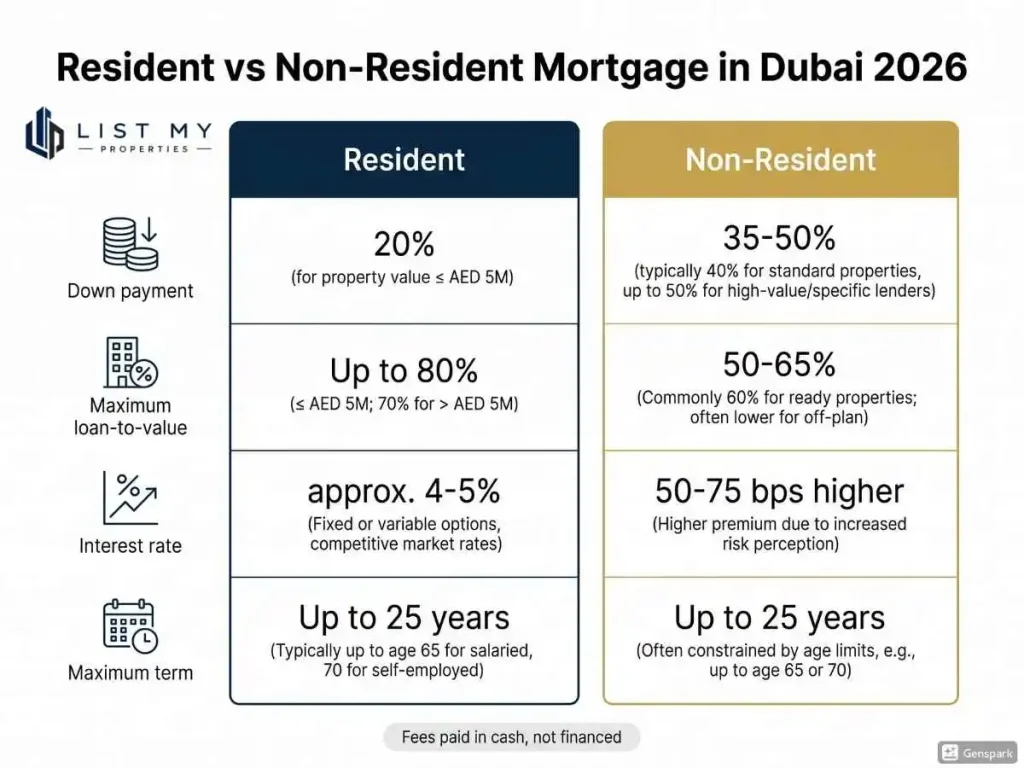
Resident vs non resident: the rules side by side
The quickest way to see where you stand is a direct comparison.
| Rule | Resident buyer | Non-resident buyer |
| Minimum down payment (under AED 5 million) | 20 percent | 35 to 50 percent, varies by bank |
| Maximum loan to value | Up to 80 percent | 50 to 65 percent |
| Interest rate range 2026 | About 4 to 5 percent | About 50 to 75 basis points higher than residents |
| Maximum loan term | Up to 25 years | Up to 25 years |
| Age at loan maturity | Around 65 to 70 | Around 65 to 70 |
The spread on the down payment is the line that matters most for your cash planning, so the calculator below lets you test different deposit percentages against your target price.
Non-Resident Mortgage Calculator
Estimate your monthly payment and total cash to buy in Dubai.
Enter your details to unlock your full mortgage estimate and a free consultation.
Please enter a valid name and phone number.
Thank you. Our team will reach out shortly.
Monthly paymentAED 0
Loan amountAED 0
Down payment neededAED 0
Total cash to buyAED 0
Which banks lend to non-residents, and on what terms
Not every UAE bank offers a non-resident product, and those that do set their own deposit and country rules. The main non-resident lenders in 2026 are Emirates NBD, Mashreq, ADCB, HSBC, FAB and DIB. As a rough picture: many ask 35 to 40 percent down, some require a full 50 percent, and a handful will go to 25 to 40 percent for strong applicants from approved countries. Your country of residence matters as much as your income; banks keep an internal list of accepted nationalities and may decline or load the rate for higher-risk jurisdictions. One practical lever most buyers miss: opening a Premier or Private banking relationship with the lender, for example with HSBC, can unlock a lower rate or a higher loan to value than the off-the-shelf non-resident product. If you bank with a global lender that also operates in the UAE, start there.


Are you eligible, and what documents you need
Eligibility for a non-resident is less about where you live and more about whether your income and credit stack up. Banks generally want you to be at least 21 at application and no more than about 65 to 70 at loan maturity, with a stable and provable income, often a minimum of around AED 15,000 equivalent per month, and a clean credit history backed by a report from your home country. Your total monthly debt, including the new mortgage, should stay within roughly 50 percent of your income.
Have these ready, ideally in English, before you apply: a valid passport and any visa page you hold; proof of income such as a salary certificate or audited accounts if self-employed; six months of personal bank statements; a credit report or reference from your home-country bank; and proof of address, plus the property documents once you choose a unit. Getting the home-country credit report translated in advance is the single biggest time-saver in a non-resident application.
What it costs beyond the down payment
The deposit is only part of the cash you need. On top of it you pay the mortgage registration fee of 0.25 percent of the loan plus AED 290 to the DLD; a property valuation fee of AED 2,500 to 3,500 plus VAT; a bank arrangement fee of around 1 percent of the loan plus VAT, sometimes discounted; and life and property insurance, usually mandatory, with life cover running about 0.3 to 0.6 percent of the outstanding loan per year. If you repay early, expect an early-settlement charge of up to 1 percent of the outstanding balance, capped under Central Bank rules. And of course you still pay the standard 4 percent DLD transfer fee and agency commission that every buyer pays. None of this can be added to the loan; it all comes from your own cash.
The currency-risk trap most guides ignore
Here is a risk bank brochures never highlight. The UAE dirham is pegged to the US dollar. If you earn in a currency that weakens against the dollar over the life of your loan, your real monthly repayment, measured in your home currency, quietly rises even though the dirham figure is unchanged. A buyer earning in a currency that drops 15 percent against the dollar effectively sees their mortgage cost jump 15 percent in home-currency terms. For a 25-year loan that is a meaningful exposure. Two sensible defences: keep a buffer of several months of payments in dirhams or dollars, and if a large share of your income is in a volatile currency, consider a shorter term or a larger down payment so the outstanding balance, and your exposure, is smaller.
The off-plan catch for overseas buyers
Many non-residents are drawn to off-plan launches for the payment plans, but financing them from abroad is harder than it looks. Most banks will not finance early-stage off-plan for non-residents; they prefer a property that is ready or close to handover, where the asset clearly exists and can be valued. If you are set on off-plan, you will often be funding the construction-stage instalments from cash and only arranging a mortgage near completion, which changes your cash-flow plan completely. Confirm a bank will lend on your specific project and stage before you sign anything.
How to get approved smoothly
- Get a pre-approval before you shop, so you know your real budget rather than guessing.
- Keep your debt low in the months before applying to protect your debt-to-income ratio.
- Have your home-country credit report ready in English to avoid delays.
- Compare at least three banks on rate, arrangement fee and early-settlement terms, not just the headline rate.
Common mistakes
- Assuming non-residents cannot borrow at all; they can.
- Forgetting that fees must be paid in cash, not financed.
- Choosing a bank on headline rate alone and ignoring the arrangement fee and country rules.
- Ignoring currency risk on a long loan when your income is in another currency.
- Counting on off-plan financing that most banks will not give a non-resident early in construction.
About this guide
About this guide – Written by Md Arshad, SEO and Digital Marketing Manager – Real Estate at List My Properties. Last updated June 2026. How we verify: the rules here are based on Central Bank of the UAE mortgage regulations current in 2026, Dubai Land Department fees, and the published non-resident lending criteria of the major UAE banks. All figures are 2026 estimates; down payment, rate and country eligibility are set by each bank and can change, so confirm a live offer before you commit. This is general information, not financial advice. Sources are listed in the external links section below.
Tips & Warnings
Pro tip 1: ask each bank for the rate after any introductory period and the early-settlement charge. A low first-year rate can cost more over the full term.
Pro tip 2: get a credit report from your home country in English before you apply. It speeds up approval and often improves your terms.
Warning 1: do not commit to a property before pre-approval. If the bank values the property below the price, you must cover the difference in cash.
Warning 2: watch the currency risk. The dirham is pegged to the US dollar, so if you earn in a currency that weakens against the dollar, your real repayment cost rises.
Insider tip: non-residents often get better terms by holding a Premier or Private banking relationship with the lender, for example with HSBC. Ask whether opening an account first unlocks a lower rate or a higher loan to value.
Key Takeaways
- The biggest hurdle for non-residents is the down payment, not approval itself.
- Plan for 35 to 50 percent down, plus fees in cash that cannot be financed.
- A strong income record and clean home-country credit history improve your terms.
- Currency risk is real on a long loan; the dirham is pegged to the US dollar.
- Pre-approval first, then compare at least three banks on rate and arrangement fee.



Sell My Property in Dubai 2026 – Free Valuation & RERA-Compliant Sale
06/06/2026
No Comments
Read More » Trusted External Sources
- Central Bank of the UAE (mortgage rules): https://www.centralbank.ae/en/
- Dubai Land Department: https://dubailand.gov.ae/en/
- UAE Government portal: https://u.ae/en
FAQs for Mortgage for Non Residents in Dubai
Can a non-resident get a mortgage in Dubai in 2026?
Yes. Several banks lend to non-residents. The main difference is a higher down payment, usually 35 to 50 percent of the property value depending on the bank, compared with a minimum of 20 percent for residents on a home under AED 5 million.
How much down payment do non-residents need in Dubai?
Plan for 35 to 50 percent of the price. Many banks ask 35 to 40 percent, some require 50 percent, and a few offer 25 to 40 percent for strong applicants, plus fees in cash.
What interest rate will I pay as a non-resident?
Rates in 2026 are roughly 4 to 5 percent, fixed or variable, and can be slightly higher for non-residents than for residents. Compare offers from several banks.
What is the maximum loan term?
Up to 25 years, subject to a maximum age at loan maturity of around 65 to 70.
What documents do non-residents need?
Passport, proof of income, six months of bank statements, a credit report from your home country, and the property documents once you choose a unit.
Can I add the fees to my mortgage?
No. The DLD fee, agency commission, mortgage registration, valuation and arrangement fees must be paid from your own cash.
Conclusion
A Dubai mortgage is very achievable for non-residents; the real planning is around the larger down payment, the cash fees and currency risk over a long term. Decide your budget, get pre-approved, then shop with confidence. Use the calculator above to see your monthly payment and the total cash you need before you make an offer.

Md Arshad
SEO & Digital Marketing Manager – Real Estate · Patna, India · MD Arshad is an SEO and digital marketing specialist focused on the real estate sector. He works as Digital Marketing Specialist at Dhruv Iconic Pvt. Ltd., a RERA-registered real estate company in Patna with 1.5+ years in the market, and has spent the last 0.5 years partnering with multiple real estate brands as a freelance SEO and content strategist. His work covers technical SEO, keyword research, competitor gap analysis, content strategy, and organic growth. He writes ListMyProperties guides to turn complex UAE real estate processes into clear, source-backed content, with every legal, tax, or fee claim referenced to official authorities such as DLD, RERA, DET, and the FTA. Connect on LinkedIn.
Leave a Reply