
15/06/2026
Marketing Strategies for Real Estate Developers 2026
By Md Arshad
Real Estate MarketingLast updated 20/06/2026
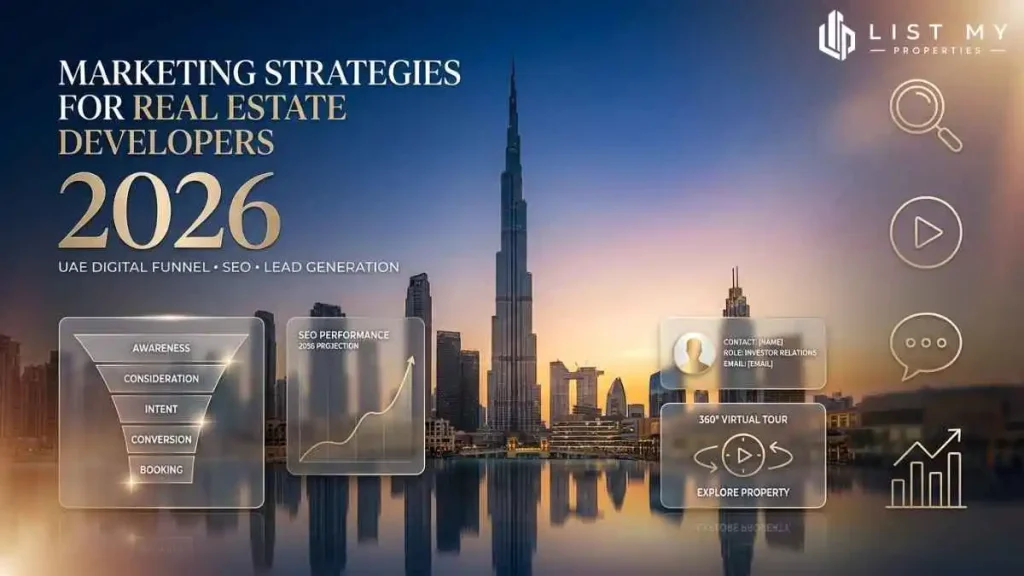
Marketing Strategies for Real Estate Developers in 2026: UAE Digital Funnel, SEO, Lead Generation and Launch Plan
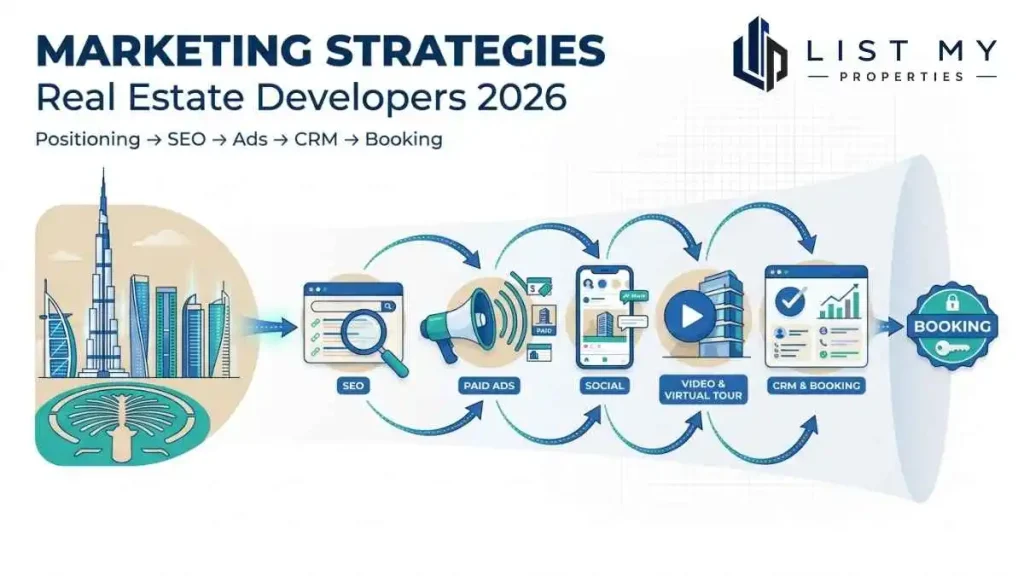
Featured Snippet Overview: The most effective marketing strategies for real estate developers include market positioning, project branding, SEO, paid search, social media campaigns, video marketing, virtual tours, landing pages, broker partnerships, email automation, CRM lead scoring, investor education, influencer outreach and post-launch retargeting. Developers should measure cost per qualified lead, booking rate, site visit rate, broker contribution, sales conversion and return on ad spend.
AI Overview Answer: Real estate developers should use a full-funnel marketing strategy that starts before launch and continues through sales, handover and resale reputation. The strongest strategy combines buyer research, project positioning, SEO, paid ads, video, interactive tools, broker partnerships, CRM automation, WhatsApp follow-up, trust-building content and performance analytics. In competitive UAE markets such as Dubai and Abu Dhabi, developers should focus on qualified leads, not only impressions or low-cost inquiries.
TL;DR:
- Real estate developer marketing should begin before project launch, not after units are ready to sell.
- The best strategy combines brand positioning, SEO, Google Ads, Meta, LinkedIn, portals, broker partnerships, video, virtual tours, email, WhatsApp and CRM automation.
- Dubai and UAE developers should market by buyer segment: end-user, investor, NRI, overseas buyer, luxury buyer, first-time buyer and broker partner.
- SEO helps capture high-intent searches such as payment plans, area guides, ROI calculators, handover timelines and developer reviews.
- Paid ads should be connected to landing pages and CRM lead scoring, not generic lead forms only.
- Video marketing, virtual tours and construction progress updates build trust before handover.
- Broker networks remain important in UAE real estate, but developers need clean project factsheets, inventory updates and lead attribution.
- The real KPI is not reach alone; it is qualified lead cost, site visit rate, booking rate, sales conversion and revenue per campaign.
Table of Contents
🏗️
Developer Marketing Budget & Funnel Calculator
Project leads, qualified leads, site visits, bookings and cost per booking for a real estate development campaign.
Step 1 · Campaign & funnel numbers
AED
AED
%
%
%
AED
%
mo
Please fill budget and cost per lead to continue.
Almost there — where should we send your launch plan?
Enter your details and we'll show results instantly + email a project launch funnel plan.
🔒 Your details are private and never shared. Used only to send your plan.
Your projected launch funnel
Booking value
—
Cost per booking
—
Expected bookings
—
Qualified leads
—
Planning only — actual performance depends on project positioning, pricing, creative, landing pages, sales follow-up and market demand.
Why Real Estate Developer Marketing Is Different from Agent Marketing
A real estate agent usually markets available listings. A real estate developer markets a project, a location, a lifestyle, a payment plan, an investment case and a future promise. This difference matters because the buyer may not be purchasing a ready unit. In off-plan real estate, the buyer is often trusting the developer’s reputation, construction timeline, escrow structure, location story, pricing strategy and expected return.
That means real estate developer marketing must do more than generate leads. It must build confidence. A developer has to explain why the project exists, who it is for, why the location makes sense, how the payment plan works, what the buyer gets at handover, and why the developer can be trusted to deliver.
In a competitive real estate market like Dubai, a weak marketing campaign can produce many low-quality inquiries but few serious bookings. A strong marketing plan filters curiosity from intent, educates the buyer, supports brokers, reduces sales friction and improves conversion rate.
1. Start with Market Positioning Before Creative Work
The first strategy for real estate developers is positioning. Before running ads or producing videos, the developer must define the project’s place in the real estate market.
A luxury waterfront tower, a family townhouse community, a mid-market apartment project, a branded residence, a commercial development and an affordable investor-led project require different messaging. If the positioning is vague, every channel becomes weaker.
A developer should answer these questions before launch:
Who is the target buyer?
Is the project for investors, end-users, first-time buyers, overseas buyers or high-net-worth clients?
What is the strongest value proposition?
Is the project about location, yield, payment plan, lifestyle, capital appreciation, developer trust or design quality?
Which competitors are nearby?
What objections will buyers have?
What proof can reduce those objections?
Good positioning becomes the foundation for SEO, paid ads, brochures, landing pages, broker pitches, LinkedIn posts, video scripts and sales calls.
2. Build a Pre-Launch Campaign Before the Project Goes Public
Real estate development marketing should begin before public launch. A pre-launch campaign creates curiosity, gathers early leads, warms brokers, tests messaging and builds a waiting list.
A strong pre-launch campaign can include teaser videos, location storytelling, early access landing pages, broker previews, investor webinars, email waitlists, WhatsApp registration, LinkedIn thought leadership, project countdowns and gated downloadable investment briefs.
The goal is not only visibility. The goal is signal. A developer can learn which buyer segments respond, which locations generate interest, what budget range is active and which objections appear before the official launch.
Pre-launch marketing also gives the sales team a stronger start. Instead of launching to a cold market, the developer launches to people who already understand the project story.
3. Use SEO to Capture High-Intent Buyer Demand
SEO is one of the strongest long-term marketing strategies for real estate developers because buyers search before they inquire. They compare areas, developers, payment plans, ROI, service charges, handover timelines, Golden Visa eligibility, floor plans and community guides.
Google’s SEO Starter Guide emphasizes building websites and content for users so search engines can crawl, index and understand the content. For real estate developers, this means the website should not be only a brochure. It should answer buyer questions clearly and be technically accessible.
A developer SEO strategy should include:
Project landing pages
Area guides
Payment plan pages
ROI calculator pages
Floor plan pages
Construction update pages
FAQ pages
Handover timeline guides
Developer credibility pages
Comparison pages
Blog content for investors and end-users
Schema markup for properties, articles, FAQs and breadcrumbs
The best SEO content is not generic. It should include real project data, official sources, location benefits, buyer objections, comparison tables, visuals and conversion CTAs.
4. Optimize for AI Search Without Chasing Fake GEO Hacks
Google’s 2026 guidance on generative AI search says foundational SEO still matters for AI features. A page must be crawlable, indexable and eligible for snippets to appear in Google’s generative AI experiences.
For real estate developers, this means AI-search visibility starts with the same basics: clear technical structure, helpful content, accurate project data, visible FAQs, schema markup, original insights and trustworthy source references.
Avoid thin “AI content” written only to rank. Instead, create pages that answer real buyer questions better than a sales brochure. Examples include “Is this project good for rental yield?”, “What is the payment plan?”, “What are the nearby schools?”, “What are the service charge expectations?”, and “How does this project compare with nearby communities?”
5. Create High-Converting Project Landing Pages
A project landing page is often the first point of contact between a buyer and a developer. It must convert attention into inquiry.
A strong real estate development landing page should include:
Clear project positioning
Hero image or video
Location map
Unit types and starting prices where allowed
Payment plan
Completion or handover timeline
Amenities
Floor plans
Investor benefits
End-user benefits
Developer credentials
Construction progress
FAQ section
Lead form
WhatsApp CTA
Broker contact option
Trust badges and official source links
The page should load fast, work perfectly on mobile and connect to CRM. Every lead should be tagged by campaign, source, keyword, property type and buyer intent.
6. Use Paid Search for High-Intent Demand Capture
Google Ads can work well for real estate developers because search intent is often clear. A buyer searching for “off-plan apartments in Dubai South” or “Dubai waterfront apartments payment plan” may be closer to action than someone casually scrolling Instagram.
Developer paid search campaigns should be split by intent:
Brand campaign
Project name campaign
Area + property type campaign
Payment plan campaign
Investment keyword campaign
Competitor comparison campaign
Remarketing search campaign
The mistake is sending all traffic to the homepage. Each campaign should have a matching landing page. A keyword about ROI should go to an ROI-focused page. A keyword about payment plans should go to a payment-plan page. A keyword about location should go to an area/project page.
7. Use Social Media for Trust, Not Just Reach
Social media platforms help real estate developers create awareness, but reach alone does not guarantee sales. Developers should use Instagram, TikTok, Facebook, LinkedIn and YouTube differently.
Instagram and TikTok work well for visual storytelling, project lifestyle, construction progress, short tours and buyer education. LinkedIn works better for B2B credibility, investor confidence, broker relationships, recruitment and corporate announcements. YouTube works well for long-form project walkthroughs, community explainers, investor webinars and buyer FAQs.
A strong social media calendar should mix:
Project teasers
Location benefits
Construction progress
Founder/developer credibility
Buyer education
Payment-plan explainers
ROI snippets
Broker training clips
Customer testimonials
Behind-the-scenes site content
FAQ reels
Live Q&A sessions
8. Use Video Marketing and Virtual Tours to Reduce Buyer Friction
Real estate is visual, and developer projects often need imagination. Buyers want to understand location, layout, finishes, view, amenities and construction progress. Video marketing helps translate a project from concept into confidence.
Effective real estate developer video formats include:
Project launch film
Founder/developer message
Architect or design story
Area walkthrough
Unit layout explainer
Amenities tour
Drone footage
Construction progress update
Broker training video
Investor webinar
Buyer FAQ video
Virtual tour or 3D walkthrough
Virtual tours and 3D experiences are especially useful for overseas buyers who cannot visit easily. They also help brokers explain the project consistently.
9. Build a Broker Enablement System
In the UAE, brokers are still a major part of real estate sales. Developers who ignore brokers lose distribution. Developers who support brokers with strong material, clear inventory and fast updates can improve reach and conversion.
Broker enablement should include:
Project factsheets
Commission structure
Inventory availability
Unit price sheets
Payment plans
Floor plans
Community guides
FAQ documents
WhatsApp-ready creatives
Short videos
Sales objection scripts
Lead registration process
Broker portal or shared inventory update
The developer should also track broker performance. Which brokers bring qualified buyers? Which channels produce bookings? Which sales objections appear repeatedly?
10. Use CRM and Marketing Automation
A developer can spend heavily on marketing and still lose buyers if follow-up is slow. CRM is one of the most important marketing tools for real estate development success.
Every lead should be captured with source, campaign, property interest, budget, buyer segment where legally appropriate, timeline, preferred communication channel and sales status. The CRM should trigger follow-up sequences by lead type.
For example, an investor downloading an ROI guide should receive different follow-up from an end-user asking about schools. A broker inquiry should receive broker material. A buyer who watched a webinar should receive a site visit invitation.
Automation can include email marketing, WhatsApp follow-up, sales reminders, retargeting audience sync, lead scoring and reactivation campaigns.

11. Use Email and WhatsApp Nurturing for Long Decision Cycles
Real estate buying decisions are rarely instant. Buyers may take weeks or months to compare projects. Developers should use email marketing and WhatsApp carefully to educate, not spam.
A good nurture sequence can include:
Project overview
Area guide
Payment plan explanation
ROI and rental yield guide
Construction progress update
FAQ answer
Webinar invitation
Broker or sales contact
Limited inventory update
Final booking CTA
The best email and WhatsApp campaigns are segmented. A buyer interested in villas should not receive only studio apartment offers. An overseas investor should receive remote-buying guidance. A first-time buyer should receive affordability and process education.
12. Create Area-Level and Buyer-Segment Campaigns
Real estate marketing becomes stronger when it matches the buyer’s location and intent. Dubai buyers do not all search the same way. A Business Bay investor, a Dubai Hills family buyer, a JVC rental-yield buyer and a Palm Jumeirah luxury buyer need different messaging.
| UAE / Dubai Segment | Buyer Intent | Best Marketing Angle | Best Channels | Content Asset |
| Business Bay | Central apartment investment, professionals | Location, rent demand, Downtown access, office tenant base | Google Search, portals, LinkedIn, Instagram | ROI and area comparison page |
| JVC | Affordable apartments, rental yield | Entry price, rental demand, service-charge comparison | SEO, Google Ads, TikTok, portals | JVC investment guide |
| Dubai Hills Estate | Family lifestyle and long-term value | Schools, parks, master community, end-user lifestyle | Instagram, YouTube, Google Search | Family buyer guide |
| Dubai South | Growth corridor and off-plan supply | Future infrastructure, airport/logistics access, affordability | Google Ads, SEO, broker webinars | Off-plan payment-plan guide |
| Palm Jumeirah | Luxury, status, global recognition | Waterfront lifestyle, scarcity, premium positioning | LinkedIn, YouTube, PR, luxury portals | Luxury buyer deck |
| Downtown Dubai | Prestige and liquidity | Landmark location, resale demand, lifestyle | Google Search, Instagram, YouTube | Prime investment comparison |
| Dubai Marina | Lifestyle and rental demand | Waterfront living, tourism, long-term rental demand | Portals, Instagram, TikTok, SEO | Buyer/renter demand guide |
| Abu Dhabi / Yas Island | End-user + investor growth | Lifestyle, entertainment, family demand | LinkedIn, Google Search, regional PR | UAE cross-emirate investment guide |
| Indian / NRI buyers | Overseas investment, residency, rental income | Remote buying, Golden Visa, payment safety, INR/AED context | YouTube, SEO, WhatsApp, webinars | NRI buyer guide |
| GCC buyers | Lifestyle, second home, capital preservation | Proximity, premium living, family use | LinkedIn, Instagram, broker partnerships | GCC second-home guide |
13. Build Trust with Proof, Not Claims
Real estate buyers are careful because the purchase value is high. Developers should build trust through proof.
Trust-building assets include:
Developer track record
Completed project case studies
Construction progress photos
Escrow and registration information where applicable
RERA/DLD references where relevant
Customer testimonials
Third-party media coverage
Awards and certifications
Clear payment plan
Transparent handover timeline
FAQs about risks and refunds
Visible office and contact details
Broker verification support
The strongest marketing strategy is not the loudest. It is the clearest, most credible and easiest to verify.
14. Use PR, Influencers and Partnerships Carefully
PR can help developers build credibility and awareness. Influencers can help create reach. But neither should replace buyer fundamentals. A celebrity, influencer or media mention can create attention, but serious buyers still check location, price, payment plan, developer record and resale potential.
Useful partnerships may include banks, mortgage advisors, relocation companies, interior designers, property management firms, broker networks, investor communities, expat groups and business councils.
A developer should choose partners who match the target market. A luxury waterfront project needs different partnerships from an affordable studio project.
15. Measure ROI Properly
A developer should not judge marketing only by impressions, likes or raw leads. Real estate marketing ROI should be measured across the full funnel.
Track these KPIs:
Cost per lead
Cost per qualified lead
Lead-to-call rate
Call-to-site-visit rate
Site-visit-to-booking rate
Booking-to-SPA rate
Cost per booking
Revenue per campaign
Broker-assisted conversion
Lead source quality
Sales response time
Retargeting conversion rate
Email and WhatsApp engagement
Organic keyword growth
A campaign that produces fewer leads but more bookings is often better than a campaign that generates thousands of low-quality inquiries.
The 4 P’s of Marketing in Real Estate Development
The 4 P’s are product, price, place and promotion. For a real estate developer, product means the project, unit mix, layout, amenities and finish. Price means pricing, payment plan and perceived value. Place means location, accessibility and community context. Promotion means the marketing channels used to generate awareness, trust and sales.
The 7 P’s of Marketing in Real Estate
The 7 P’s expand the model to product, price, place, promotion, people, process and physical evidence. In real estate, people include the sales team, brokers and customer service. Process includes inquiry handling, booking, SPA signing and handover. Physical evidence includes show units, brochures, virtual tours, construction progress and completed projects.
The 3-3-3 Rule for Real Estate Marketing
The 3-3-3 rule can be used as a practical content framework: create three buyer hooks, three proof points and three CTAs for every campaign. For example, a Dubai off-plan project might use hooks around payment plan, location and ROI; proof points around developer track record, DLD/escrow status and construction progress; and CTAs for brochure download, WhatsApp inquiry and site visit booking.
90-Day Marketing Plan for a Real Estate Development Project
| Timeline | Focus | Key Actions | KPI |
| Days 1–15 | Strategy and positioning | Buyer persona, competitor audit, project USP, budget, funnel design | Positioning approved |
| Days 16–30 | Asset creation | Landing page, brochure, video, floor plans, CRM setup, broker kit | Campaign assets ready |
| Days 31–45 | Pre-launch | Teaser ads, waitlist, broker preview, SEO pages, webinar | Early leads and broker interest |
| Days 46–60 | Launch | Google Ads, Meta, LinkedIn, portals, PR, YouTube, WhatsApp | Qualified leads and site visits |
| Days 61–75 | Optimization | A/B testing, lead scoring, retargeting, broker feedback | Lower CPL and better qualification |
| Days 76–90 | Conversion | Sales events, urgency messaging, inventory updates, nurturing | Bookings and SPA pipeline |
Common Mistakes Real Estate Developers Make
The first mistake is starting marketing too late. A developer should create demand before launch, not after inventory is sitting unsold.
The second mistake is using the same message for every buyer. Investors, end-users, brokers and overseas buyers need different proof points.
The third mistake is relying only on paid ads. Paid traffic stops when the budget stops. SEO, content, PR and broker partnerships build longer-term visibility.
The fourth mistake is poor follow-up. Many real estate leads are lost because the sales team responds too slowly or does not understand the buyer’s intent.
The fifth mistake is focusing on vanity metrics. Impressions and likes are useful, but bookings and sales conversion matter more.
Trusted External Sources
- Dubai Land Department — Dubai Real Estate Transactions Q1 2026
Use this in the UAE market context section to show the scale and momentum of Dubai real estate activity. - CBRE — UAE Real Estate Market Review Q1 2026
Use this when discussing market fundamentals, residential transaction activity, office demand and supply conditions. - DataReportal — Digital 2026: The United Arab Emirates
Use this in the digital marketing section to support UAE internet, mobile and social media context. - Google Search Central — SEO Starter Guide
Use this in the SEO section to support crawlability, indexability and user-first content guidance. - Google Search Central — Optimizing for Generative AI Features on Google Search
Use this in the AI-search section to explain that foundational SEO remains relevant for AI Overviews and AI Mode. - Google Search Central — AI Features and Your Website
Use this when explaining AI-search eligibility, snippets and crawl/index requirements. - Matterport — Real Estate Marketing Ideas
Use this in the video/virtual tour section to support immersive property marketing ideas. - Stonehaven — Real Estate Marketing Strategies for UAE Developers
Use this as a UAE competitor/reference source for developer marketing strategy, VR and digital storytelling. - Sell.Do — Real Estate Marketing Strategies by Experts
Use this in the CRM and lead management section as a supporting source for real estate lead nurturing and automation. - Dubai Land Department — Dubai REST
Use this when advising developers and buyers to connect marketing claims with official property services and data where relevant.
FAQ
What are the most effective marketing strategies for real estate developers?
The most effective strategies include project positioning, SEO, paid search, social media campaigns, video marketing, virtual tours, broker partnerships, CRM automation, email nurturing, WhatsApp follow-up, PR, influencer partnerships and performance analytics.
What are the 4 P’s of marketing in real estate?
The 4 P’s are product, price, place and promotion. In real estate development, product means the project and unit mix, price means pricing and payment plan, place means location and community, and promotion means the marketing channels used to attract buyers.
What are the 7 P’s of marketing in real estate?
The 7 P’s are product, price, place, promotion, people, process and physical evidence. For developers, people include sales teams and brokers, process includes lead handling and booking, and physical evidence includes show units, brochures, virtual tours and construction updates.
How can real estate developers use digital marketing?
Developers can use digital marketing through SEO, Google Ads, Meta campaigns, LinkedIn, YouTube, TikTok, landing pages, email, WhatsApp, CRM automation, virtual tours and retargeting campaigns.
What is the 3-3-3 rule for real estate marketing?
The 3-3-3 rule can be used as a simple campaign framework: three buyer hooks, three proof points and three CTAs. It helps keep a campaign focused, clear and conversion-oriented.
Why are pre-launch campaigns important for developers?
Pre-launch campaigns build early interest, test buyer demand, warm brokers, collect qualified leads and create momentum before the official project launch.
What should be included in a real estate developer marketing plan?
A marketing plan should include positioning, buyer personas, competitor audit, budget, channel strategy, landing pages, content plan, paid ads, broker enablement, CRM setup, lead scoring, follow-up workflows and ROI measurement.
How can developers build trust with buyers?
Developers can build trust through completed project proof, construction updates, transparent payment plans, official registrations where applicable, buyer FAQs, testimonials, media coverage, professional visuals and clear contact details.
What role does video marketing play in real estate development?
Video marketing helps buyers understand the project story, location, lifestyle, floor plans, amenities, construction progress and developer credibility. It is especially useful for overseas buyers and broker education.
How do developers measure marketing ROI?
Developers should track cost per lead, cost per qualified lead, site visit rate, booking rate, cost per booking, SPA conversion, revenue per campaign, broker contribution, sales response time and lead source quality.
Conclusion
Marketing strategies for real estate developers must connect brand, project, buyer intent and sales execution. A developer cannot rely only on attractive renders or generic ads. Buyers want proof, clarity, location logic, payment-plan confidence, developer credibility and fast follow-up.
The best strategy is full-funnel. It starts with positioning and pre-launch demand creation, then uses SEO, paid media, social content, video, broker partnerships, CRM automation, PR and retargeting to move buyers from awareness to inquiry, site visit, booking and final sale.
For UAE and Dubai developers, the opportunity is strong, but competition is also high. Developers who build trust, answer buyer questions and measure qualified lead quality will outperform those who chase only reach and low-cost leads.
Key Takeaways
- Real estate developer marketing should begin before launch.
- Positioning is the foundation of every campaign.
- SEO captures long-term buyer intent and supports AI-search visibility.
- Paid ads should send traffic to focused landing pages, not generic homepages.
- Social media should build trust, not only reach.
- Video and virtual tours reduce buyer friction.
- Broker partnerships remain essential in UAE real estate.
- CRM automation improves follow-up and lead quality.
- Marketing ROI should be measured by qualified leads, bookings and sales—not only impressions.
- Developers should build proof, transparency and buyer education into every campaign.
Disclaimer: This article is for general marketing and business information only. It is not financial, legal, advertising compliance or guaranteed growth advice. Real estate marketing results depend on market conditions, budget, offer strength, creative quality, sales follow-up, compliance, channel performance and buyer demand.

Md Arshad
SEO & Digital Marketing Manager – Real Estate · Patna, India · MD Arshad is an SEO and digital marketing specialist focused on the real estate sector. He works as Digital Marketing Specialist at Dhruv Iconic Pvt. Ltd., a RERA-registered real estate company in Patna with 1.5+ years in the market, and has spent the last 0.5 years partnering with multiple real estate brands as a freelance SEO and content strategist. His work covers technical SEO, keyword research, competitor gap analysis, content strategy, and organic growth. He writes ListMyProperties guides to turn complex UAE real estate processes into clear, source-backed content, with every legal, tax, or fee claim referenced to official authorities such as DLD, RERA, DET, and the FTA. Connect on LinkedIn.
Leave a Reply