

Commercial Property Value Estimator: A Smarter CRE Valuation Calculator for Commercial Properties
AI Overview
A commercial property value estimator helps owners, brokers, investors, and lenders calculate a realistic value range for income-producing real estate. The most reliable estimate usually combines three methods: the income approach using net operating income and cap rate, the sales comparison approach using comparable sales, and the cost approach using land value, replacement cost, and depreciation. A free commercial property value estimator can provide a rough estimate online, but a certified appraiser is still needed for lending, tax, legal, or formal appraisal decisions. For the best result, users should enter accurate rent, expenses, occupancy, building size, lot size, property type, condition, and market details.
How do you estimate commercial property value?
To estimate commercial property value, calculate the property’s net operating income, divide it by the local market cap rate, compare the result with recent sales of similar properties, and check whether the replacement cost plus land value supports the estimate. The most balanced commercial property value estimate uses a hybrid range instead of relying on one valuation method.
Formula examples:
- Income Approach: Property Value = NOI / Cap Rate
- Sales Comparison: Property Value = Adjusted Price per Square Foot × Building Size
- Cost Approach: Property Value = Land Value + Replacement Cost - Depreciation
A commercial property value estimator gives owners, investors, brokers, and business operators a practical starting point for understanding what a building may be worth before ordering a full appraisal. Commercial properties are not valued like typical homes. A retail strip center, warehouse, office building, medical space, mixed-use asset, apartment building, or leased industrial site depends on income, lease strength, location, construction quality, market demand, operating expenses, zoning, and comparable sales.
This guide explains how a modern commercial property value estimate works, why a hybrid valuation model feels more accurate than a single formula, and how a property owner can use a free commercial property value estimator before speaking with a broker, appraiser, lender, or buyer. It is written for the USA market using USD and square feet, but the same principles apply to many commercial real estate valuation decisions.
The purpose is not to replace a certified real estate appraisal. Instead, it helps a user estimate commercial property value in a clear, responsible, and conversion-friendly way. A strong estimator should provide a teaser value range first, then unlock a detailed PDF report after the user submits contact details. That gives the audience useful insight while helping the website generate qualified commercial property leads.
Why Commercial Property Value Matters
Commercial property value matters because it affects selling price, financing power, insurance planning, tax conversations, investor returns, and business decisions. A building that looks valuable from the street may underperform if rent is below market, vacancy is high, expenses are rising, or tenant credit is weak. On the other hand, a plain-looking warehouse in a strong logistics corridor may have a higher current value because its income streams are durable and demand is strong.
For an investor, valuation is the starting point for underwriting. The investor needs to understand market value, cash flow, debt service coverage ratio, loan-to-value ratio, expected return, and exit strategy before making informed investment decisions. For an owner, determining commercial property value helps answer practical questions such as “Should I sell my commercial property?”, “Can I refinance?”, “Is my property underinsured?”, or “What is the value of my commercial property today?”
The IRS describes fair market value as the price property would sell for on the open market between a willing buyer and seller, with neither forced to act and both having reasonable knowledge of the relevant facts. In the world of commercial real estate, that means accurate information is essential. A rough online estimate can start the conversation, but the quality of the final opinion depends on data, lease details, market conditions, comparable sales, and professional judgment.
Commercial Property Value Estimator
Estimate a commercial property value range using a hybrid valuation model: income approach, sales comparison, and cost approach.
Teaser range first. Full PDF report after contact details.
What Is a Commercial Property Value Estimator?
A commercial property value estimator is an online calculator or valuation tool that uses owner-submitted inputs to produce a commercial property estimated value or value range. A premium tool should not simply ask for one number. It should collect property type, building size, lot size, address, year built, condition, occupancy, gross rental income, operating expenses, cap rate, land value, and local market class. These inputs help calculate commercial property value with more accuracy and precision.
A strong estimator also explains the difference between a commercial property value estimate online and a formal appraisal. The estimate is useful for lead qualification, early feasibility, investment screening, and owner education. A certified appraiser should still be used for lending, litigation, tax disputes, estate planning, and regulated appraisal needs.
The best version is a hybrid commercial real estate property value estimator. It combines the income approach, sales comparison approach, and cost approach. Instead of presenting one fragile number, it gives a value range, a midpoint estimate, and confidence indicators. This feels more premium to elite customers because commercial real estate is rarely valued by one formula alone.


Property Tax vs Real Estate Tax: Are Real Estate Taxes the Same as Property Taxes?

How Long Does It Take to Get a Real Estate License? 2026 Career Guide
Best Ways to Estimate Commercial Property Value
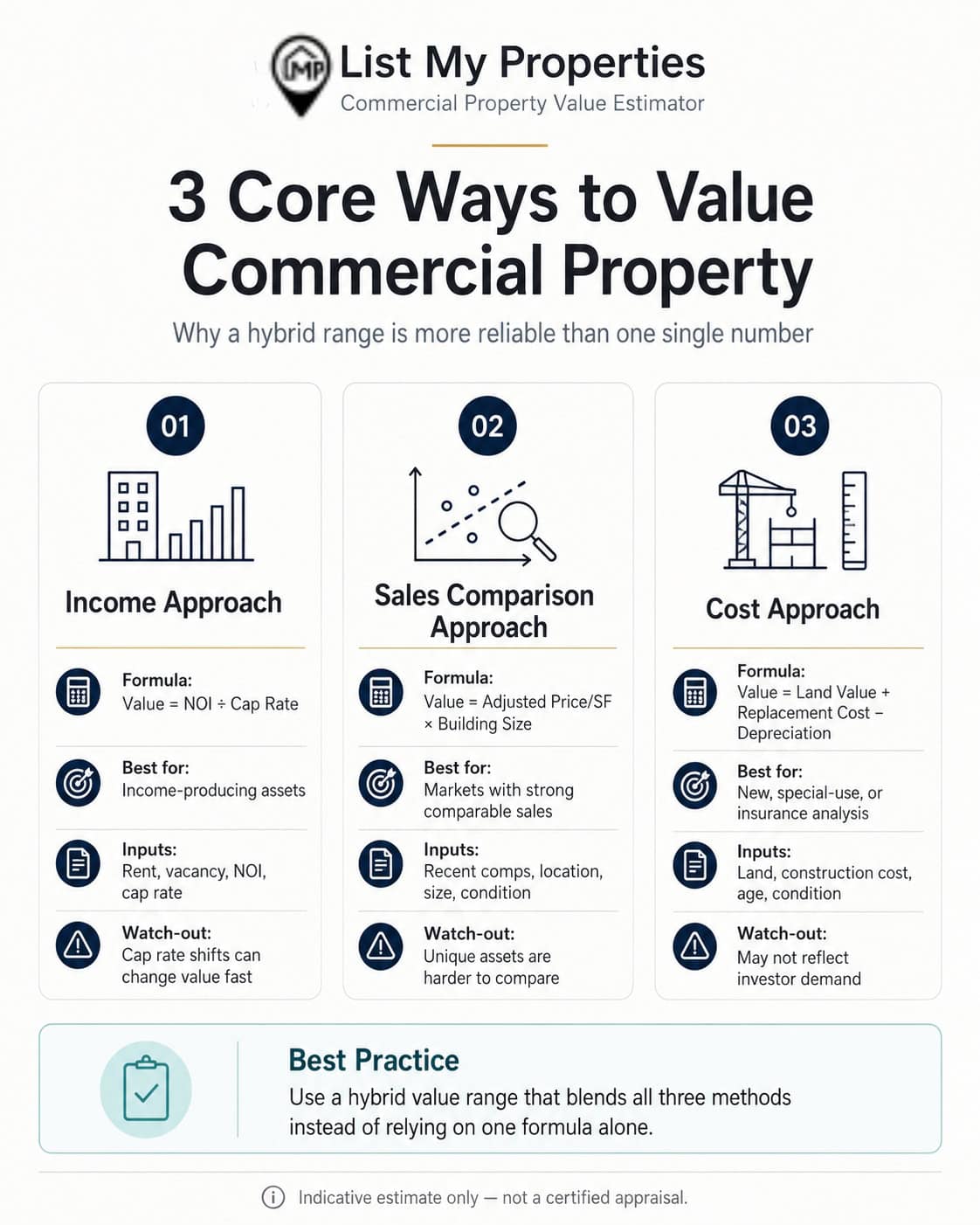
The best ways to estimate commercial property value methods depend on the type of property and the quality of available data. Income-producing properties usually rely heavily on NOI and cap rate. Owner-user buildings often need sales comparison and replacement cost logic. Special-use properties may need cost approach, construction cost, depreciation, land value, and zoning analysis.
A useful commercial property estimated value calculator should explain the strengths and weaknesses of each valuation method. It should also remind users that property values change as interest rate expectations, rent growth, cap rate movement, vacancy, operating expense inflation, local demand, and comparable properties change.
Income Approach: NOI, Cap Rate, and Capitalization
The income approach is one of the most common methods for estimating commercial property value. It starts with net operating income, also called NOI. NOI is generally calculated by subtracting operating expenses from gross income. Debt service, income tax, depreciation accounting, and capital reserves may be treated separately depending on the analysis.
The basic capitalization formula is simple: property value equals NOI divided by the capitalization rate. If a commercial property produces $250,000 in annual NOI and similar properties in the same market trade around a 6.25% cap rate, the income approach indicates a value of about $4,000,000. This is why the question, “If investment, what’s your NOI and what’s the going cap rate for that type of building in your area?” is so important.
The income capitalization approach works best when current income is reliable and lease data is available. It is especially useful for rental properties, office buildings, retail centers, multifamily assets, industrial buildings, and stabilized commercial properties. However, it can mislead users if rent is temporary, expenses are missing, occupancy is inflated, or the selected cap rate does not match the actual risk of the asset.
Sales Comparison Approach: Comparable Sales and Price Per Square Foot
The sales comparison approach estimates the value of a property by comparing it with similar properties that sold recently. The appraiser, broker, or investor looks at comparable sales data, sales in the area, location, building condition, square footage, zoning, access, parking, tenant quality, lease term, and property type. The result is often expressed as price per square foot, per door, per unit, or per key depending on the asset.
This method is powerful when enough comparable properties exist in the same market. It is often useful for small office buildings, retail condos, warehouses, mixed-use properties, land parcels, and owner-user commercial buildings. It is less reliable when the property is unusual, the market has few recent transactions, or the building has below-market leases that affect the property’s value.
A commercial property value estimate by address can use location data and nearby sales to create an early benchmark. Still, commercial properties are more complex than residential homes. A true estimate commercial property value by address should never rely only on map data. It should also account for income, condition, occupancy, tenant strength, deferred maintenance, zoning, and availability of similar properties.
Cost Approach: Land Value, Replacement Cost, and Depreciation
The cost approach estimates value by calculating land value plus the replacement cost of the building, minus depreciation. It is especially useful for new buildings, specialty properties, insurance analysis, tax assessment review, and situations where comparable sales are limited. It also helps explain how agencies estimate commercial property value for insurance because insurance often focuses on rebuilding cost rather than market sale price.
Replacement cost can change quickly as labor, materials, permitting, and construction financing costs move. A building may be expensive to rebuild but not worth the same amount to a buyer if market rent is weak. This is why market value of commercial property and insurance replacement cost should not be treated as the same number.
A hybrid estimator should include cost approach logic, but it should not let construction cost dominate the full result unless the property type requires it. For example, an active medical building, school, warehouse, or special-use structure may need a deeper cost approach review than a simple stabilized retail property.
Hybrid CRE Valuation: Why a Range Beats One Number
A premium commercial property value estimator should produce a range instead of a single figure. A range feels more honest because commercial real estate valuation depends on uncertain inputs. Cap rates move, buyers negotiate, interest rates affect leverage, appraisers adjust comparable sales differently, and market trend data can shift within months.
A hybrid model can assign weights to multiple methods. For example, a stabilized retail or multifamily asset may give more weight to income approach, while a newer owner-user industrial building may give more weight to sales comparison and cost approach. A vacant or redevelopment property may require more emphasis on land value, zoning, highest and best use, and comparable land sales.
A professional estimator can display a low, midpoint, and high result. The low range may reflect conservative cap rate and expense assumptions. The midpoint may reflect balanced assumptions. The high range may reflect stronger rent, lower cap rate, better buyer demand, or superior property condition. This lets owners estimate your commercial property value without being misled by one overly precise number.
Commercial Property Value Formula Table
| Valuation Method | Formula | Best For | Weakness |
|---|---|---|---|
| Income Approach | NOI / Cap Rate | Stabilized income-producing assets | Sensitive to cap rate and NOI quality |
| Sales Comparison | Adjusted $/SF × Square Footage | Active markets with recent comparable sales | Weak if comps are limited or not truly similar |
| Cost Approach | Land Value + Replacement Cost – Depreciation | New, special-use, insurance, tax assessment | May not reflect buyer demand or income strength |
| Gross Rent Multiplier | Price / Gross Rental Income | Quick screening and small rental assets | Ignores operating expenses |
| Per Door | Value / Number of Units | Multifamily, hotels, senior housing | Must adjust for unit mix and income |
| Cost Per Rentable Square Foot | Price / Rentable SF | Office, industrial, retail | Must compare same building class and market |
| Discounted Cash Flow | Present Value of future cash flows | Large assets and institutional deals | Requires detailed assumptions |
Factors Affecting Commercial Property Values
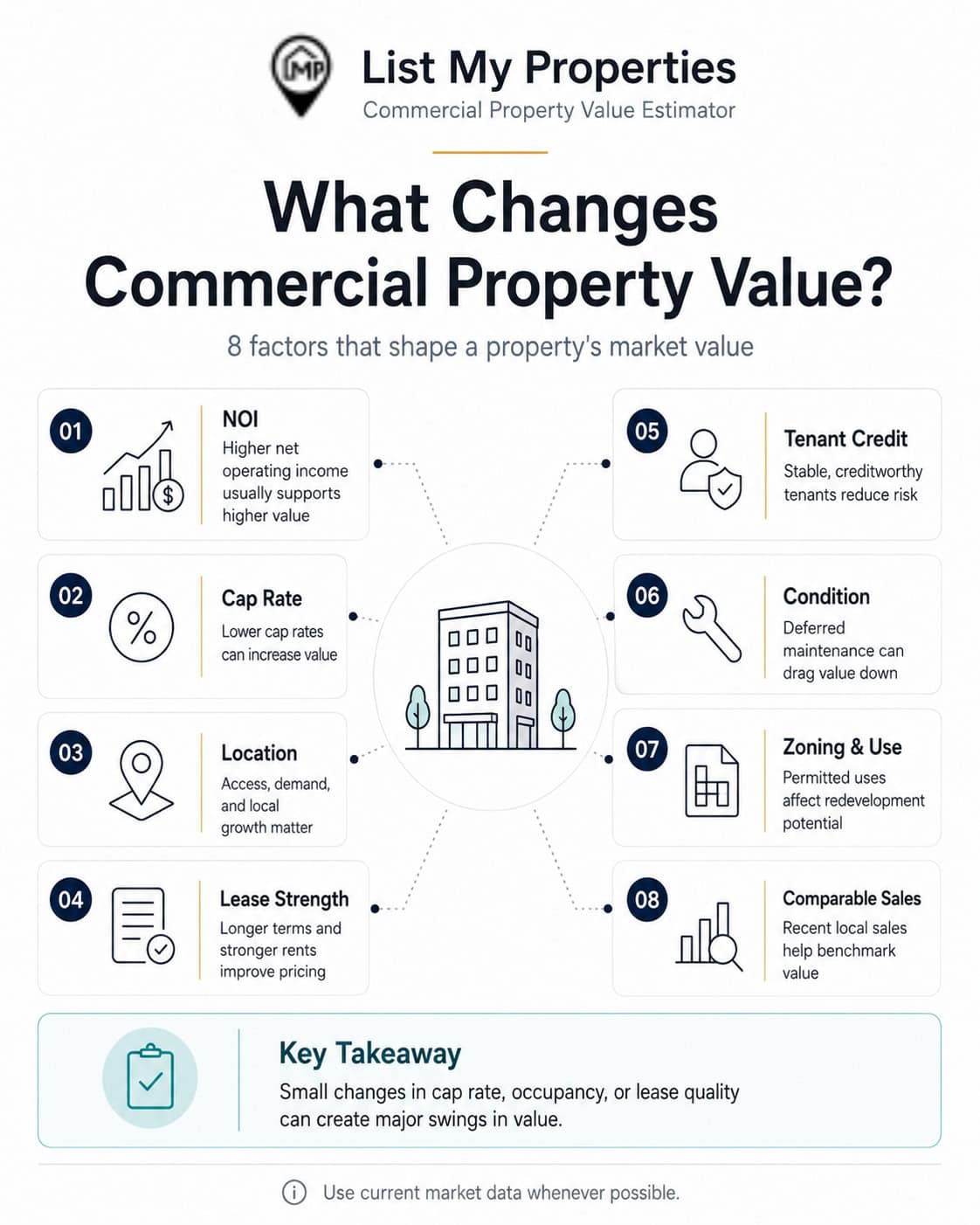
Several key factors affect commercial property values. Location is still critical, but it is not the only driver. A great address with a weak tenant, short lease, or heavy deferred maintenance may underperform. A secondary-market industrial asset with strong access, functional loading, and solid current income may outperform expectations.
Market conditions also matter. CBRE’s 2026 U.S. real estate outlook expects commercial real estate investment activity to increase and cap rates for most property types to compress modestly, which can support property values when income remains stable. At the same time, lenders, investors, and buyers still care about debt cost, rate of return, market trend, and risk.
Other factors affecting valuation include property type, building age, construction quality, square footage, lot coverage, parking, zoning, lease term, credit strength, tenant rollover risk, expense ratio, tax exposure, insurance costs, environmental concerns, and future supply. A good property value estimator commercial tool should request enough information to capture these variables without overwhelming users.
Commercial Property Value Estimator by Address: What It Can and Cannot Do
A commercial property value estimator by address can provide location-based insight, especially when combined with sales data, neighborhood demand, and local market assumptions. Address-level data may help identify county, zip code, parcel size, tax assessment, surrounding land use, traffic access, and nearby comparable properties.
However, commercial property value estimates by address are not enough on their own. Unlike residential houses, commercial buildings may have unique leases, special zoning, environmental history, tenant improvements, vacant space, unusual layouts, or redevelopment potential. Two buildings beside each other can have very different values if one has long-term credit tenants and the other has unstable income.
That is why a free commercial property value estimator should ask for income and property details in addition to address. The more accurate the inputs, the more useful the estimated commercial property value becomes.
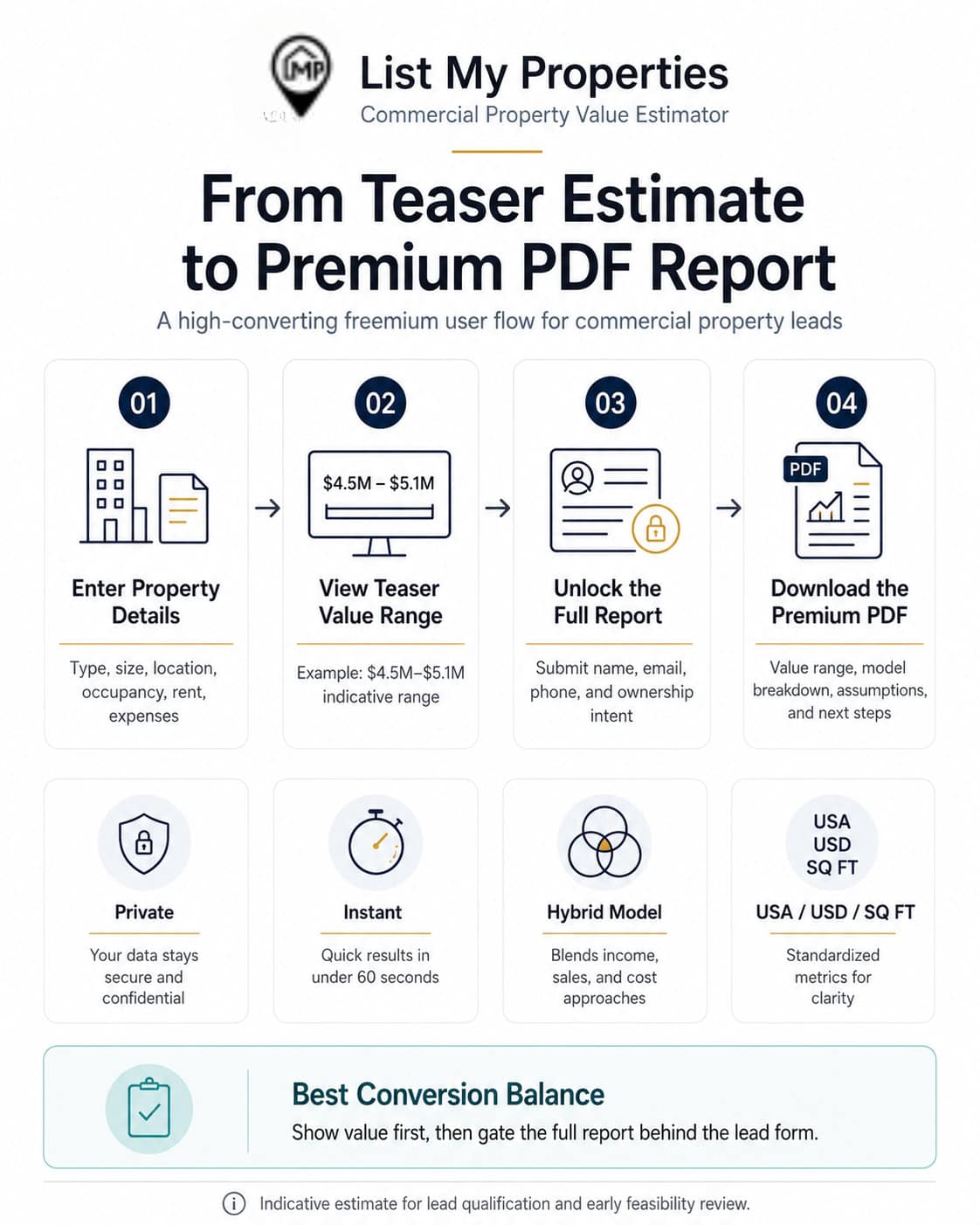
Free Commercial Property Value Estimator: Best User Flow for Leads
The best user flow is a freemium model. First, the website shows a short form with property details. Then it provides a teaser range, such as “Your indicative value range may be $2.8M to $3.3M.” After that, the full PDF report is locked behind a lead form asking for name, email, phone, ownership status, and reason for valuation.
This works because the visitor receives value before being asked for contact details. The teaser builds trust, and the PDF report feels worth unlocking. For premium UI/UX, the report should include branded headings, badges, executive interpretation, property snapshot, valuation method breakdown, assumptions, confidence score, and recommended next steps.
A high-converting flow should also explain that the result is an indicative commercial property estimated market value, not a certified appraisal. This protects the business and improves trust. The website should invite users to request a professional review if they are buying, selling, refinancing, litigating, or making tax-related decisions.
Example Commercial Property Value Estimate
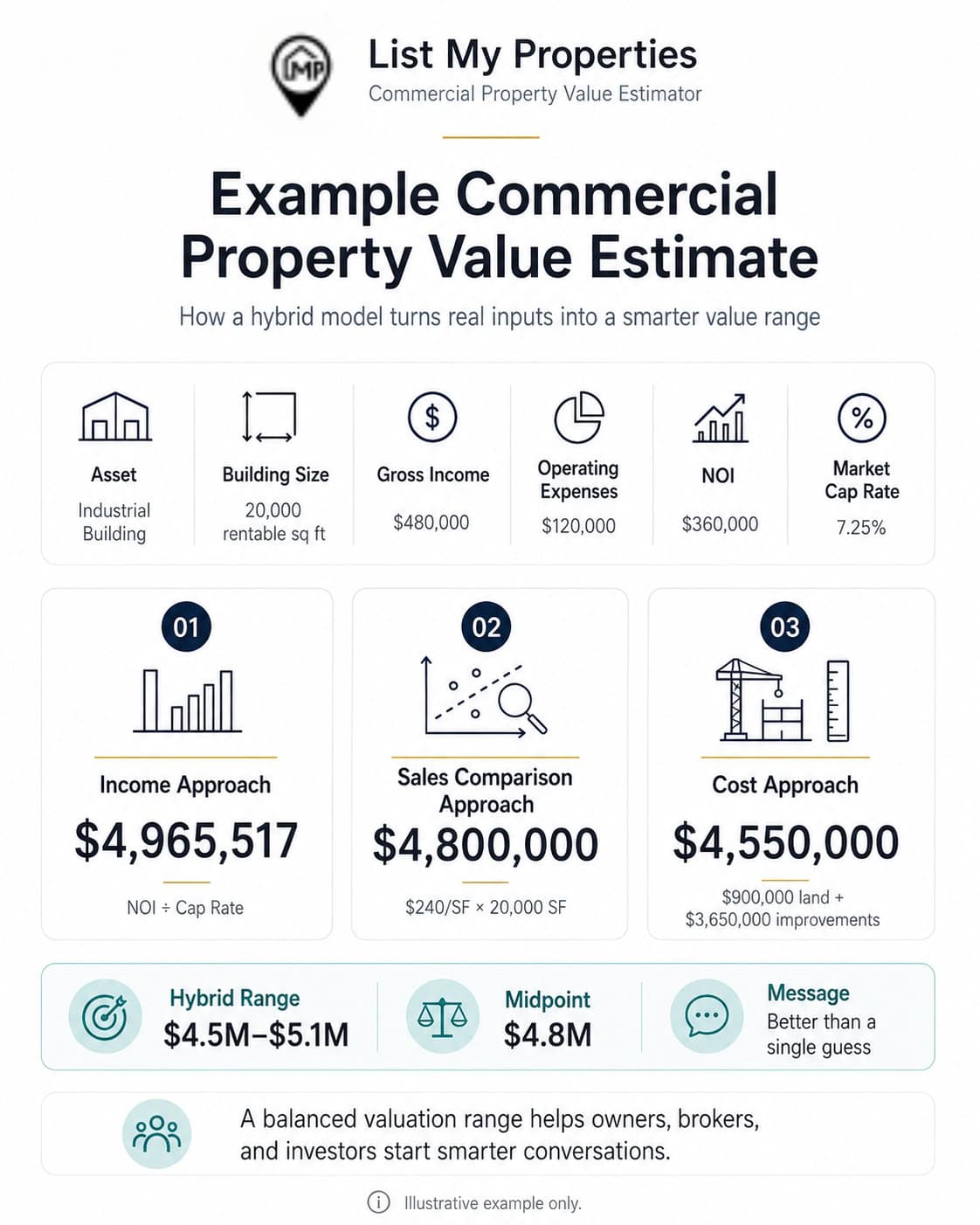
Assume an industrial building has 20,000 rentable square feet, annual gross income of $480,000, operating expenses of $120,000, and stabilized occupancy. The NOI is $360,000. If similar properties in the same market trade near a 7.25% cap rate, the income approach estimate is approximately $4,965,517.
If comparable sales suggest $240 per square foot, the sales comparison estimate is $4,800,000. If the land value is $900,000 and the replacement cost after depreciation is $3,650,000, the cost approach estimate is $4,550,000. A hybrid model may conclude a commercial property value estimate range of about $4.5M to $5.1M, with a midpoint near $4.8M.
This is not a formal appraisal, but it is much better than guessing. It helps the owner understand whether a sale conversation, refinance, broker opinion of value, or full appraisal may be worth exploring.
Commercial Property Valuation vs Appraisal vs Broker Opinion of Value
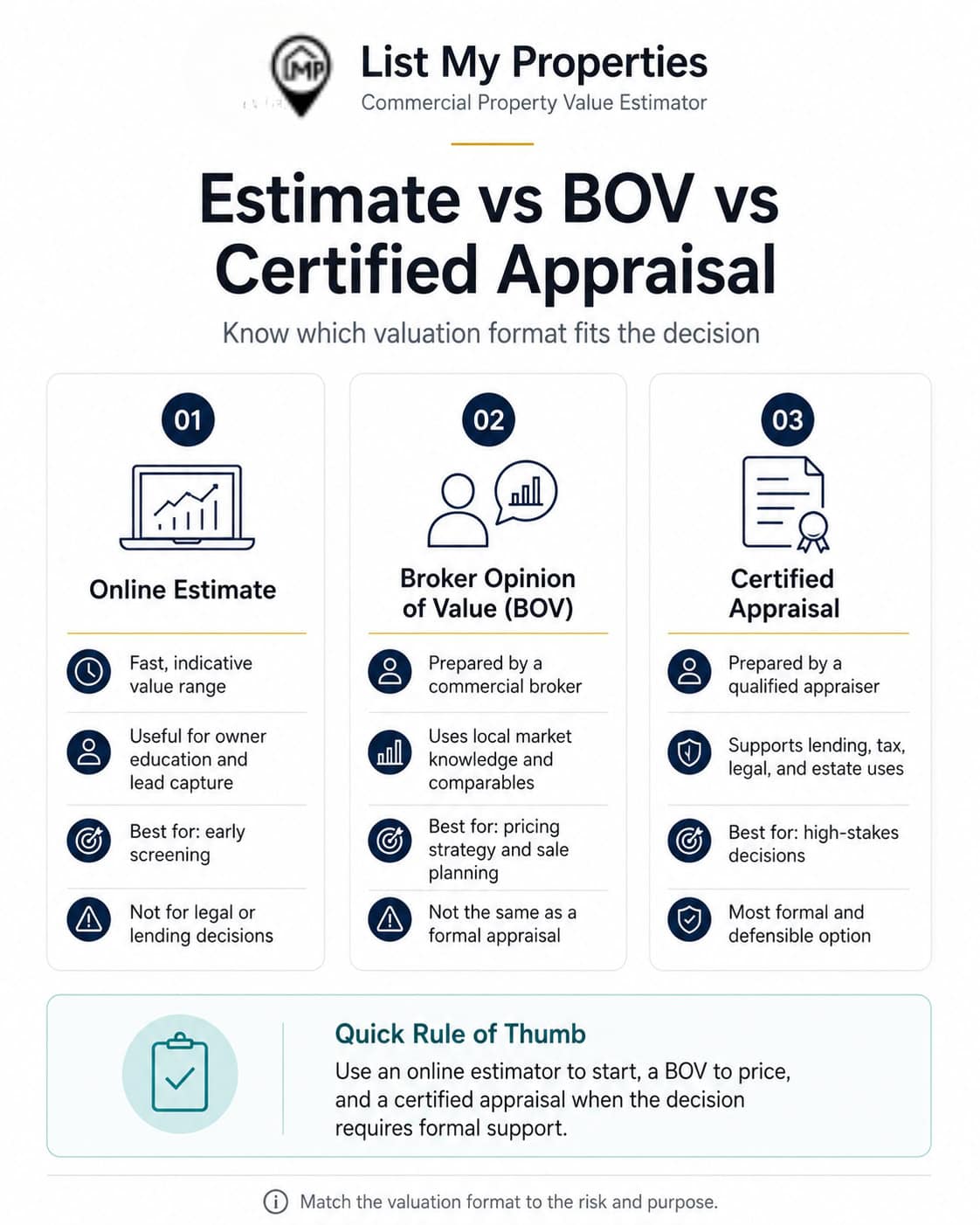
Commercial property valuation is a broad term. It may refer to an online estimate, investor underwriting, broker pricing opinion, appraisal, tax assessment, or internal portfolio analysis. A commercial property value estimator free online tool is usually a preliminary estimate. It is useful for education and lead generation.
A broker opinion of value, often called a BOV, is usually prepared by a commercial real estate broker using market knowledge, comparable sales, leasing activity, and buyer demand. A certified appraisal is prepared by an appraiser who follows professional standards and is often required for federally related lending transactions.
Appraisal standards exist to promote trust in analyses, opinions, and conclusions. For financial, tax, legal, or lending decisions, a property owner should work with qualified professionals. A free commercial property value estimate should be positioned as a starting point, not the final word.
Best Commercial Property Value Estimator Tools for Tax Assessment and Insurance
The best commercial property value estimator tools for tax assessment should help owners compare assessed value with current market value, recent sales, income trends, and property condition. Tax assessments may lag the market, and local rules vary by county and state. Owners should review property tax notices carefully and consult a tax advisor or property tax professional when needed.
For insurance, the focus may shift from market value to replacement cost. Agencies estimate commercial property value for insurance by considering construction type, finishes, HVAC, plumbing, fire protection, foundation, building code requirements, and rebuild cost. The estimated value commercial property owners need for insurance may differ from the estimated market value a buyer would pay.
A strong article should educate users on this difference because it builds E-E-A-T and prevents confusion. It also creates a natural internal link opportunity to pages about commercial insurance replacement cost, tax assessment review, and commercial appraisal services.
FAQ: Commercial Property Value Estimator
How to calculate the value of a commercial property?
Calculate NOI, divide it by a market cap rate, compare the result with similar properties, and check the cost approach if replacement cost or land value is important. A hybrid model usually gives a better range.
What is the 2% rule in commercial real estate?
The 2% rule is a rough rental property screening idea that monthly rent should equal about 2% of purchase price. It is not reliable for most commercial real estate valuation because commercial properties depend on NOI, cap rate, lease quality, and market conditions.
How much is a business worth with $500,000 in sales?
Business value is different from commercial property value. A business with $500,000 in sales may be valued using profit, EBITDA, assets, growth, and industry multiples. The building itself should be valued separately unless the business and property are being sold together.
How to work out the price of a commercial property?
Use the income approach, sales comparison approach, and cost approach. Then adjust for property type, lease, occupancy, condition, market demand, and financing environment.
How do you value a commercial real estate property?
Most professionals value commercial real estate by analyzing income, expenses, cap rate, comparable sales, replacement cost, land value, and investor return requirements.
Is there a website that gives a ballpark value of a commercial property?
Yes, an online commercial property value estimator can give a ballpark range. However, commercial real estate is more specialized than residential property, so the estimate should be reviewed by a broker or appraiser before major decisions.
Should I sell my commercial property?
The decision depends on the current value, income, future rent growth, tax position, debt, buyer demand, and the owner’s investment goals. A valuation estimate can help start the decision.
What affects valuing commercial real estate?
NOI, cap rate, comparable sales, location, construction, lease term, tenant credit, occupancy, expenses, zoning, interest rates, property condition, and market trend all affect valuation.
What approach is best for commercial property valuation?
The best approach depends on the asset. Income approach is often best for stabilized rental properties. Sales comparison is useful in active markets. Cost approach is useful for new, special-use, or insurance-related analysis.
What type of property can be estimated?
Office, industrial, retail, multifamily, mixed-use, medical, warehouse, hospitality, land, and special-use properties can be estimated, but each type requires different assumptions.
Why does commercial property value matter?
It influences selling strategy, refinance ability, insurance planning, tax review, investment decisions, and negotiation strength.
Conclusion
A commercial property value estimator is most useful when it gives a realistic range, explains the valuation method, and encourages the user to verify assumptions with professionals. The best approach is hybrid: combine NOI and cap rate, comparable sales, price per square foot, replacement cost, land value, and property-specific risk. A free commercial property value estimator can start the conversation, while a premium PDF report can turn that visitor into a qualified lead.
Key Takeaways
- Commercial property value is not the same as residential Zestimate-style pricing.
- The income approach uses NOI and cap rate.
- The sales comparison approach uses comparable properties and adjusted price per square foot.
- The cost approach uses land value, replacement cost, and depreciation.
- A value range is more trustworthy than one exact number.
- Address-based estimates should also include income, condition, occupancy, and lease data.
- Insurance replacement cost and market value can be very different.
- A certified appraiser is needed for formal lending, tax, legal, or regulated valuation decisions.
- The freemium teaser-plus-PDF report flow is ideal for lead generation.
Trusted External Sources

Md Arshad
Digital Marketer in Real Estate · listmyproperties.com · 2 Years Experience
Md Arshad specializes in real estate content marketing and home improvement education, helping US homeowners navigate renovation decisions with clear, data-driven guidance. He covers bathroom renovation costs, contractor hiring, and renovation ROI across the listmyproperties.com platform.

Join The Discussion