


How Much Does a Real Estate Agent Make Per Sale?
Understanding the real estate agent’s commission structure is essential for both aspiring agents and home buyers. The earnings of a real estate agent per sale vary depending on multiple factors such as commission percentage, sale price, brokerage fees, and the agent’s experience. In this article, we’ll explore how real estate agents earn per sale, the factors affecting their income, and the key aspects that influence agent commissions in the property market.
Table of Contents
AI Overview
What does a real estate agent make per sale?
A real estate agent earns a commission, typically between 2.5%-3% of the home’s sale price. The total commission is usually split between the listing agent and the buyer’s agent. The agent’s earnings depend on the sale price, brokerage split, and commission structure. In addition to commissions, agents may incur costs like marketing and transaction fees, affecting their overall take-home pay.


Property Tax vs Real Estate Tax: Are Real Estate Taxes the Same as Property Taxes?

What Is a Real Estate Agent’s Commission?
A real estate agent’s commission is a percentage of the sale price of the property they help sell or buy. The commission is usually split between the listing agent (representing the seller) and the buyer’s agent (representing the buyer), with each receiving a portion of the total commission.
Typical Commission Rate
The average commission rate for real estate agents is between 5% and 6% of the final sale price.
This commission is typically divided between the listing agent and the buyer’s agent, with each receiving 2.5% to 3%.
For example, on the sale of a $300,000 home, the total commission may be $18,000 (assuming a 6% total commission), with $9,000 going to the listing agent and $9,000 to the buyer’s agent, before any brokerage splits.
How Much Does a Real Estate Agent Make Per Sale?
To understand how much an agent earns per sale, let’s break down the various factors that impact commission.
Factors That Affect a Real Estate Agent’s Earnings Per Sale
Sale Price of the Property: The higher the sale price, the higher the commission.
Example: A $1 million sale at a 3% commission rate would yield $30,000 for the agent.
Commission Split with Brokerage: Most agents work for a brokerage, which takes a percentage of the commission. This can range from 10% to 50%, depending on the agent’s experience and the terms of their agreement with the brokerage.
Commission Structure: Some agents work on a flat fee per transaction, while others are paid on a commission-only basis. The commission model can significantly affect earnings.
Negotiation and Market Conditions: In a competitive market, agents may negotiate higher commission rates or take on more properties to increase their earnings.
Example Calculation:
For a $500,000 property:
Total Commission: 5% = $25,000
Split between Listing Agent and Buyer’s Agent: $12,500 each
Brokerage Split (assuming 30% taken by the brokerage): $3,750
Agent’s Take-home: $8,750 (after brokerage split)
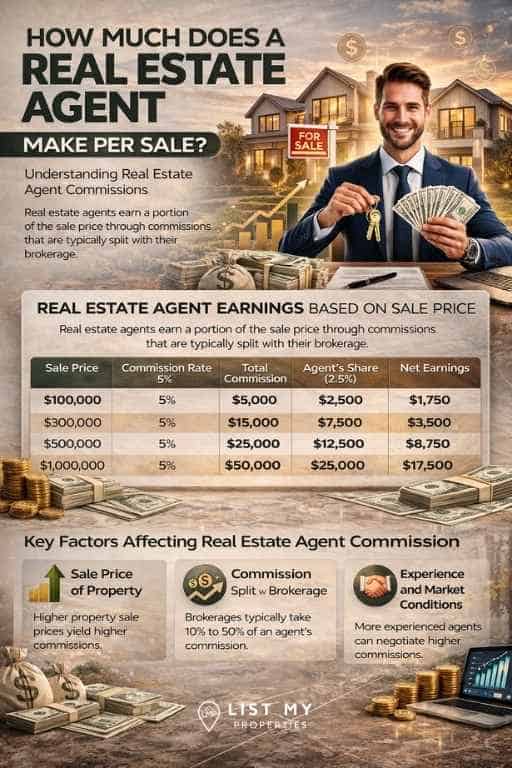
Data Table: Real Estate Agent Earnings Based on Sale Price
| Sale Price | Commission Rate | Total Commission | Agent’s Share (2.5%) | Broker Split (30%) | Net Earnings |
|---|
| $100,000 | 5% | $5,000 | $2,500 | $750 | $1,750 |
| $300,000 | 5% | $15,000 | $7,500 | $2,250 | $5,250 |
| $500,000 | 5% | $25,000 | $12,500 | $3,750 | $8,750 |
| $1,000,000 | 5% | $50,000 | $25,000 | $7,500 | $17,500 |
How Does the Commission Structure Work in Real Estate?
Real estate agents usually follow a commission-based payment model, meaning their earnings are dependent on the success of their transactions. Here’s a breakdown of the commission structure:
Total Commission: The total percentage of the sale price that is divided between the buyer’s and listing agents.
Brokerage Split: Real estate agents don’t receive the full commission. They share a percentage with the brokerage firm that supports them. This split can be negotiated, especially for experienced agents.
Transaction Fees: Agents may also incur additional fees such as advertising, marketing, and MLS listing fees.

How Long Does It Take to Get a Real Estate License? 2026 Career Guide

Can a Property Owner Block an Easement? Legal Rights, Remedies & State Laws Explained

Frequently Asked Questions (FAQ)
1. How much do real estate agents make per sale?
Real estate agents typically make 2.5% to 3% of the sale price. For example, on a $300,000 home, they could earn $7,500 before brokerage splits.
2. What factors affect a real estate agent's earnings?
Key factors include the sale price of the property, the commission structure, brokerage split, and the agent’s experience.
3. How does the commission split work for real estate agents?
The commission is split between the listing agent and the buyer’s agent, and each agent shares a portion of their earnings with their brokerage.
4. How do real estate agents get paid?
Real estate agents earn commission based on the sale of properties. They receive a percentage of the sale price, with the amount split between the buyer’s and seller’s agents and their brokerages.
5. Can real estate agents make more money from higher-priced properties?
Yes, the commission is directly tied to the sale price, so agents earn more from higher-priced homes.
Conclusion
In conclusion, real estate agents earn commissions based on a percentage of the home sale price, typically 2.5% to 3% per transaction. These earnings vary depending on the sale price, commission rate, brokerage agreements, and expenses. Understanding the real estate agent’s income structure is essential for both agents and buyers when entering the market. Real estate agents who handle high-value properties or multiple transactions can make substantial earnings, but it’s important to remember that brokerage splits and operational expenses can impact net earnings.
Key Takeaways:
Real estate agents make between 2.5% to 3% of the sale price per transaction.
The brokerage split affects the agent’s earnings.
Agents can earn more with higher-value properties and multiple sales.
Trustworthy External Links
National Association of Realtors (NAR) – Offers extensive resources on real estate agents, commission rates, and market statistics.
Zillow – Provides real estate information, commission breakdowns, and resources for both buyers and sellers.
Investopedia – A reliable source for understanding how commission structures work and factors affecting agent earnings in real estate.



Join The Discussion