


Real Estate License Timeline 2026: How Long Does It Take to Get Licensed and Become a Real Estate Agent?
Getting a real estate license is one of the fastest ways to start a real estate career—but “fast” depends on the state, the real estate education hours required, the license exam schedule, the application process, and how quickly a candidate finds a sponsoring real estate broker. In plain terms, the long does it take question has a real answer: most people finish in 2–6 months, some finish faster, and some take longer.
This guide is worth reading because it doesn’t stop at generic estimates. It lays out a practical, step-by-step timeline, the biggest “hidden” delays (fingerprints, background check, missing documents, exam availability), and state examples with official sources—so readers can estimate the time it will take with fewer surprises.
Table of Contents
AI Overview (Zero-Click Summary for Google AI Overviews)
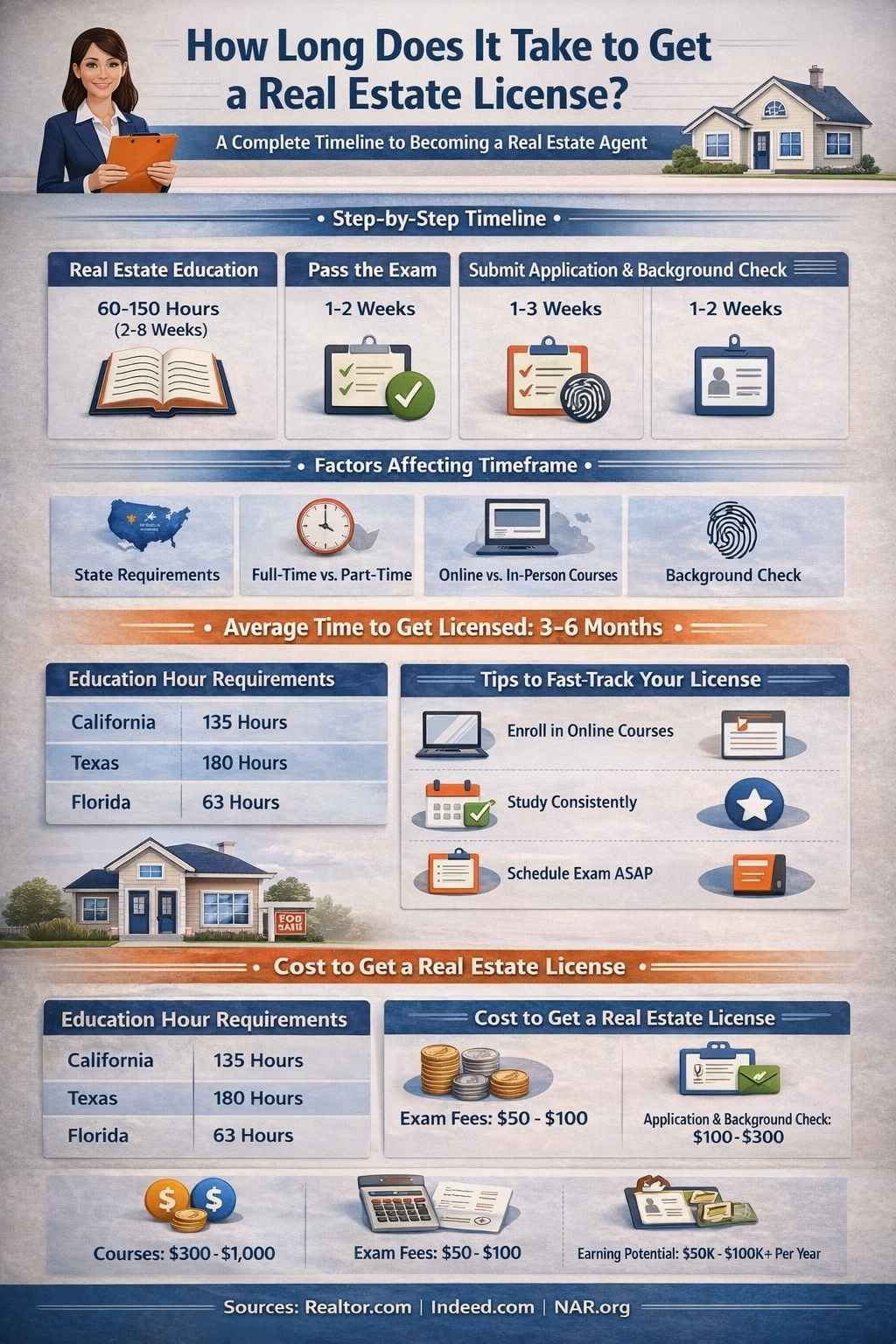
How long does it take to get a real estate license? In most U.S. states, it typically takes 2–6 months from starting the pre-license course to receiving an active license—depending on required course hours, how fast the candidate completes an online course, how soon they schedule your state exam, and how quickly the state processes the license application. Fast-track candidates may finish in 4–8 weeks, while delays (failed exams, incomplete applications, background issues) can push the process to 6–12 months.
Featured-snippet style answer
A real estate license usually takes 2–6 months to earn. The timeline includes pre-licensing coursework, the real estate license exam, fingerprints/background check, the license application, and (in many states) joining a sponsoring broker to make the license active.
Table: Typical timeline to get a real estate license (2026)
| Stage (from “start to licensed”) | What happens | Typical time range |
|---|---|---|
| 1) Pre-license education | Complete required real estate course hours (in-person or course online) | 2–12 weeks (pace-dependent) |
| 2) Exam prep + scheduling | Study, then take the exam / state exam | 1–4 weeks |
| 3) Fingerprint + background check | Fingerprint submission and background check review | 2 days–4 weeks |
| 4) License application | Apply for your license, pay fees, upload documents | 1–3 days (plus corrections if needed) |
| 5) State processing | Agency reviews and issues license (or requests fixes) | 1–8 weeks |
| 6) Sponsoring broker / activation | Get a sponsoring broker; license becomes active (state-dependent) | 1 day–4 weeks |
Practical reality: The “process could take” 4–8 weeks for a fast-track candidate, but take anywhere from 2–6 months for most people—and could take longer if the exam is failed or the application is incomplete.
Step-by-step: How long does it take to get a real estate license?
This section answers the exact query variations people type—real estate license how long does it take to get, how long does it take to get your real.estate license, and similar. The steps below apply broadly, but license requirements vary by state.
1) Pre-license education (real estate school vs online course)
Pre-license real estate education requirements determine the base timeline. A candidate must complete the required real estate courses before the real estate license exam in most states. The fastest candidates treat this like a short sprint: daily study blocks, weekly checkpoints, and finishing the course without long gaps.
Choosing online vs classroom matters. A self-paced online real estate school can reduce calendar time if the student moves quickly, but it can also “take longer” when the schedule isn’t consistent. A classroom program is slower on the calendar but adds structure and accountability—useful for candidates who struggle to keep momentum.
2) The license exam (and why scheduling can add weeks)
The license exam (often called the real estate exam or state exam) has two time costs: preparation + scheduling. Even if the candidate is ready, the earliest available test date may be days or weeks away in busy seasons. That single constraint is one reason long it will take varies so much across states and cities.
Exam strategy impacts timeline too. When a candidate fails, re-testing windows and additional prep time can push the plan back by weeks. That’s why many state pages emphasize planning and matching IDs, names, and application details to avoid last-minute blocks.
3) Fingerprints and background check (the quiet bottleneck)
Many states require real estate fingerprinting and a background check. Even when the candidate completes coursework quickly, licensing can stall if fingerprint results are delayed or if the state requests additional documentation.
Texas is explicit that fingerprints must be on file and that a license won’t issue until the background check is passed—this is a real-world reason the timeline can expand beyond “just finishing the course.”
4) Submit the application (and avoid “incomplete” delays)
After the exam (or sometimes before, depending on state design), the candidate must submit your application and pay the fee. States often break licensing into phases, where missing uploads, incorrect answers, or delayed third-party documents cause the biggest slowdowns. Pennsylvania’s licensing resources explain the multi-phase nature of processing and why incomplete submissions increase wait time.
This is where simple mistakes add weeks: mismatched names, missing education proof, incomplete criminal history explanations, or failing to attach required forms.
5) Sponsoring broker and “active license” (why “licensed” isn’t always “working”)
Some states issue a license that is not yet “work-ready” until the candidate joins a sponsoring broker. Texas notes that after meeting requirements, an applicant may be issued an inactive license and must be sponsored by an active Texas licensed broker for an active license that allows work.
That single step changes the timeline from “license issued” to “start your real estate career.”
State examples (official hour requirements that affect how long it takes)
The biggest timeline driver is the state’s required education hours. Below are examples that commonly appear in search queries like “how long does it take to get a real estate license in California” or “how long.does.it.take.to.get real.estate license in texas”.
California (CA): education hours and realistic timeline
California requires 135 hours of pre-licensing education for a salesperson license.
Because those hours are fixed, the timeline becomes a pacing equation: candidates who study 15 hours/week finish coursework in ~9 weeks; candidates who study 7–8 hours/week take closer to 4 months before even reaching the exam stage.
A candidate aiming for a “real estate license within three months” in California must keep a consistent weekly pace and avoid delays in scheduling and application review.
Texas (TX): 180 hours + fingerprints + sponsorship
Texas requires 180 classroom hours across specific qualifying courses.
Texas also highlights fingerprint requirements and that a license will not issue if the background check has not been passed—so late fingerprinting can delay the finish line.
Finally, Texas clearly explains sponsorship: an applicant needs a sponsoring broker to move from inactive to active.
This is why “how.long does it take to get your real estate license” in Texas often includes time to find a broker, not just course + exam.
Florida (FL): 63-hour pre-license course
Florida is well-known for a 63-hour pre-license course requirement for sales associates.
This can be faster on paper than higher-hour states, but the same constraints apply: exam scheduling, fingerprints, and application processing still determine how quickly the license arrives.
Pennsylvania (PA): 75 hours and structured processing phases
Pennsylvania requires 75 hours of approved education for the salesperson license.
Pennsylvania also publishes clear guidance on processing phases and why responding quickly to missing items reduces delays—useful for candidates trying to keep the timeline predictable.
Summary Table: Real Estate Licensing Requirements by State (2026)
State | Pre-Licensing Hours | Minimum Age | Background Check | Estimated Timeline |
Florida | 63 Hours | 18 | Required | 2-3 Months |
California | 135 Hours | 18 | Required | 4-6 Months |
Texas | 180 Hours | 18 | Required | 4-6+ Months |
New York | 77 Hours | 18 | Required | 3-4 Months |
Massachusetts | 40 Hours | 18 | Required | 2-3 Months |
Michigan | 40 Hours | 18 | Required | 2-3 Months |
Mission Beach Vacation Rentals: Your Ultimate Guide to San Diego’s Coastal Getaway
Factors that determine how long it takes (the real reasons timelines vary)
Even with identical course hours, two candidates can finish months apart. These are the most common “time expanders” seen across licensing journeys.
Study pace, learning style, and educational technology
A candidate’s weekly consistency matters more than “motivation.” A self-paced online real estate pre-license program can finish faster if the candidate keeps a fixed routine. Without that routine, the same coursework stretches out and the process becomes open-ended.
This is where good learning tools (practice exams, spaced repetition, a weekly score tracker) turn educational technology into a measurable timeline advantage.
Exam availability and retake rules
Many candidates underestimate how long scheduling can take, especially in large metro areas. When a candidate tries to “take your test within” a narrow date range, limited seats can force a later date. A failed attempt adds retake wait time and additional prep.
Application mistakes and missing documents
The fastest candidates treat the license application like a checklist project: correct IDs, consistent names, clear education proof, and full uploads on day one. Pennsylvania’s guidance explains that application processing includes phases where missing information triggers delays.
Background check issues (and early pre-checks)
A prior record doesn’t always mean denial, but it often means more review. Some states offer preliminary determination paths; when available, completing those early prevents “surprise delays” after the exam.
Sponsoring broker timing
For candidates in states that require sponsorship to activate, the timeline depends on networking and interview speed. A candidate who lines up a broker early can often “license and start” working faster once the license is issued.
Fast-track plan: the fastest way to get your real estate license (without cutting corners)
A fast-track candidate focuses on reducing idle days between steps:
Week 1–2: Commit to a pace and finish 25–35% of the course
A realistic plan is 2–3 hours/day on weekdays plus one longer weekend session. This approach keeps course momentum high and reduces the odds the candidate drops off mid-way.
Week 3–5: Finish coursework + book the exam early
Many candidates wait to schedule until they “feel ready.” The faster approach: lock an exam date first, then study backward from it. That eliminates drifting.
Week 6–8: Exam, fingerprints, and submit your application immediately
As soon as the exam is passed, the candidate submits fingerprints and completes the application package in one clean batch. This is how some people finish in “weeks to get” licensed rather than months.
Costs (what candidates typically pay—and what’s often forgotten)
Costs vary by state and provider, but the major buckets are predictable:
Pre-license course tuition (online or classroom)
Exam fee(s)
Fingerprints/background check fees
Application and license issuance fees
Post-license education (in some states)
Optional: test prep tools
A candidate should also budget for “startup” expenses after licensing (association dues, MLS fees, brokerage onboarding). Even though these aren’t required to earn your license, they affect how quickly a new agent can operate professionally.
After the license is issued: what happens next?
This is the part many competitors under-explain, even though the CSV keyword cluster shows people search it constantly (“after passing real estate exam what next”).
Working as a real estate agent (first 30 days)
A new licensed real estate agent typically:
Joins a sponsoring broker (if not already)
Completes onboarding, compliance, and contract training (real estate law, contract forms)
Sets up lead generation basics (CRM, open house process, scripts)
Learns local MLS rules (via multiple listing service access through brokerage/associations)
Income reality check (latest data)
Income varies wildly by market, hours, and experience. The U.S. Bureau of Labor Statistics reports median pay (May 2024) of $56,320 for real estate sales agents and $72,280 for brokers.
NAR’s 2025 Member Profile-based reporting shows median gross income rising to $58,100 (in 2024 reporting), and highlights how strongly income increases with experience.
This matters for timeline expectations: candidates rushing a license without a plan for training and lead flow often extend the “time to first commission” even if the license arrives quickly.
UK answer (FAQ requirement): How long does it take to get a real estate license in the UK?
In the UK, estate agents generally do not need a government-issued licence in England, though training/qualifications can help employability.
For example, apprenticeships can take 1 year to 1.5 years depending on the route.
So the UK “license” question is often really a question about training time, not a legal licensing clock like in many U.S. states.

Can a Property Owner Block an Easement? Legal Rights, Remedies & State Laws Explained
Conclusion
A real estate license timeline isn’t just “course + exam.” It’s a chain: required education hours, exam access, fingerprints and background checks, application accuracy, state processing, and—sometimes—finding a sponsoring broker to activate the license. With a fast-track plan and fewer mistakes, many candidates can finish in weeks; without structure, the same process can stretch for months.
Bullet-point summary: most important things to remember
The typical timeline is 2–6 months, but fast-track candidates may finish in 4–8 weeks.
Course hours are the base driver (CA 135, TX 180, FL 63, PA 75).
Exam scheduling and retakes can add weeks, even if coursework is done.
Fingerprints and the background check can become the silent bottleneck.
Application accuracy matters: incomplete submissions trigger delays.
In some states, a sponsoring broker is required to make the license active.
Some Trustworthy External Links:
FAQ
How long does it take to get a real estate license?
Most candidates complete the process in 2–6 months, depending on course hours, exam scheduling, and application processing.
How much does it cost to get a real estate license?
Costs vary by state and provider, but typically include course tuition, exam fees, fingerprints/background check fees, and state application fees.
How much do real estate agents make on a house sale?
Most agents earn commission-based income that varies by brokerage splits and local market norms. Median pay data shows wide ranges across experience levels.
How long does it take to get a real estate license in California?
California requires 135 hours of education, so timeline depends heavily on weekly study pace.
How long does it take to get a real estate license in Texas?
Texas requires 180 hours, fingerprints/background check, and sponsorship to activate the license.
How much does it cost to get a real estate license in Florida?
Florida costs vary, but the core requirement is the 63-hour pre-license course plus exam and application fees.
What is the fastest way to get a real estate license?
A fast-track plan combines a consistent daily schedule, early exam booking, and same-day application submission after passing.
How long does it take to get a real estate license in the UK?
In England, estate agents typically don’t need a government licence; timelines relate to training routes like apprenticeships.
How hard is the real estate exam?
Difficulty depends on preparation quality and test-taking skills. Candidates who treat prep as a structured project reduce retake delays.


Join The Discussion