


How to attract international real estate buyers in 2026 (a practical playbook for listings, global reach, and trust)
International buyers are actively searching for property in the U.S. and other major markets, but they do not shop the same way local clients do. They compare cities like Miami, Tampa, Florida markets, New York, and gateway metros through a global lens: safety, lifestyle, schools, rental potential, currency exchange impact, tax exposure, and how easy it is to buy property from abroad. That means the same listing, presented with local-only marketing, often fails to convert global buyers.
This guide explains how to attract international real estate buyers using proven international marketing steps that real estate professionals can execute in 2026. It includes current data, a table for quick strategy planning, and infographic-ready blocks. It also covers working with international buyers safely (documents, lawyers, title insurance, and FIRPTA basics), while keeping the content easy to follow and built for zero-click search intent.
AI Overview
To attract international real estate buyers in 2026, real estate professionals should combine global-ready listings (high-quality photography, floor plans, video tours, walkthroughs, drone footage) with targeted international marketing, multilingual communication, and strong trust signals such as verified credentials, clear transaction guidance, and local market expertise. Current data shows foreign buyers purchased $56 billion worth of U.S. existing homes from April 2024 to March 2025, with a record median price of $494,400 and 47% paying all-cash, making premium presentation and fast response essential. Successful agents reach international buyers by listing on global platforms, building referral networks, earning international designations like CIPS, partnering with brokers abroad, and simplifying cross-border steps including financing, currency exchange, and tax rules such as FIRPTA.
Featured snippet answer
How to attract international real estate buyers:
Attract international real estate buyers by targeting the countries and cities most likely to invest, listing properties on global real estate platforms, using high-quality photography and video tours, offering clear floor plans and key measurements, supporting multilingual communication, and building trust through credentials, reviews, and a transparent transaction process. International buyers often purchase remotely and may pay cash more frequently, so fast response times, virtual walkthroughs, and strong local market expertise help convert global buyers.


Property Tax vs Real Estate Tax: Are Real Estate Taxes the Same as Property Taxes?

Latest data (what the 2025 report says and why it matters in 2026 planning)
Foreign buyers are not a “tiny niche” if the listing and marketing are structured for global transactions. According to the National Association of Realtors®, international buyers purchased $56 billion worth of U.S. existing homes from April 2024 through March 2025, with 78,100 properties, and a record median purchase price of $494,400. The same release notes that 47% paid all-cash (compared to 28% among all buyers), which changes how agents should position urgency, proof of funds, and remote viewing.
This matters for a real estate agent because a global buyer is often comparing the property in the U.S. against options in Canada, Germany, Australia, the UK, or even other U.S. states. When a listing lacks clarity, buyers imagine problems: hidden costs, unclear square footage, uncertain neighborhood context, or complicated closing steps.
Step 1: Pick the right international buyers (country, intent, and budget)
Attract international real estate buyers starts with understanding who is likely to buy and why. International buyers are not one audience. Some are buying a home internationally for relocation, some want a second home, and some foreign investors want cash-flow or long-term asset growth. NAR distinguishes international clients as resident foreigners and non-resident foreigners, which helps clarify their buying constraints and timelines.
A simple segmentation that works in real estate marketing:
relocation buyers (schools, commute, visa timeline, community fit)
investment buyers (rentability, taxes, property management, yield expectations)
lifestyle and luxury buyers (amenity, privacy, luxury lifestyle narrative, brand-level presentation)
diaspora buyers (language, cultural comfort, family proximity)
This is where a real estate business should align its message and listing structure. If the listing is aimed at investment, it should show rental comps, HOA rules, and property management options. If it is luxury real estate, it should “lead with lifestyle, not just features,” because global buyers need an emotional anchor when buying a home remotely.
Step 2: Make the listing globally understandable (the “remote buyer test”)
Many listings are written for local clients who already know the city, the style of homes, and the process. International clientele do not have that context. They want clarity.
A global-ready listing should include:
high-quality photography and videography (consistent lighting, wide angles)
floor plans with square footage clearly shown
walkthroughs and video tours that show flow, not just highlights
drone footage for neighborhood context (where relevant)
clear “what’s included” notes for appliances, fixtures, parking, storage
an amenity list that is specific and measurable (not vague)
AgentFire emphasizes visual content, multilingual accessibility, and lifestyle benefits when attracting international buyers.
A luxury marketing view also supports the same concept: if a property cannot be understood remotely, it struggles to attract international buyers.
Small details reduce hesitation:
convert or display measurements clearly (sq ft, lot size, room sizes)
add a short neighborhood explainer (transport, safety, shopping, schools)
include a short “buying a home in the U.S.” timeline summary for buyers from abroad
Step 3: Use video tours that feel like a decision tool, not a promo
Video tours are not optional for global buyers in 2026. They are part of the decision workflow. A real estate agent who records a slow, complete walkthrough with stable camera motion, labeled rooms, and natural lighting creates confidence.
A high-performing video tour stack:
60–90 sec highlight reel (social + ads to reach)
5–10 minute full walkthrough (serious buyers)
3D tour (when property type supports it)
short clips for bedrooms, kitchen, view, and amenity features
GoCRR specifically highlights professional photography and videography as essential to bridge the distance for buyers who cannot tour in person, and also recommends partnering with international real estate agents.
Step 4: List where global buyers search (not only local MLS)
MLS visibility is important, but it is not the same as a global listing strategy. International buyers may search online on portals that serve their country and language habits. Some platforms matter more in specific regions, and the safest approach is to use a multi-channel “global listing” distribution plan.
Practical approach:
keep MLS correct and complete (it feeds many syndications)
build a dedicated landing page per listing on your site (fast, clean, translated sections as needed)
syndicate to luxury and international portals (market-dependent)
use YouTube + Google Business Profile posts for reach and credibility
retarget engaged viewers with ads (only after the listing page is strong)
AgentFire’s guide stresses “list where they search” and suggests region-specific portals, plus multilingual support and international SEO to help foreign buyers discover listings.
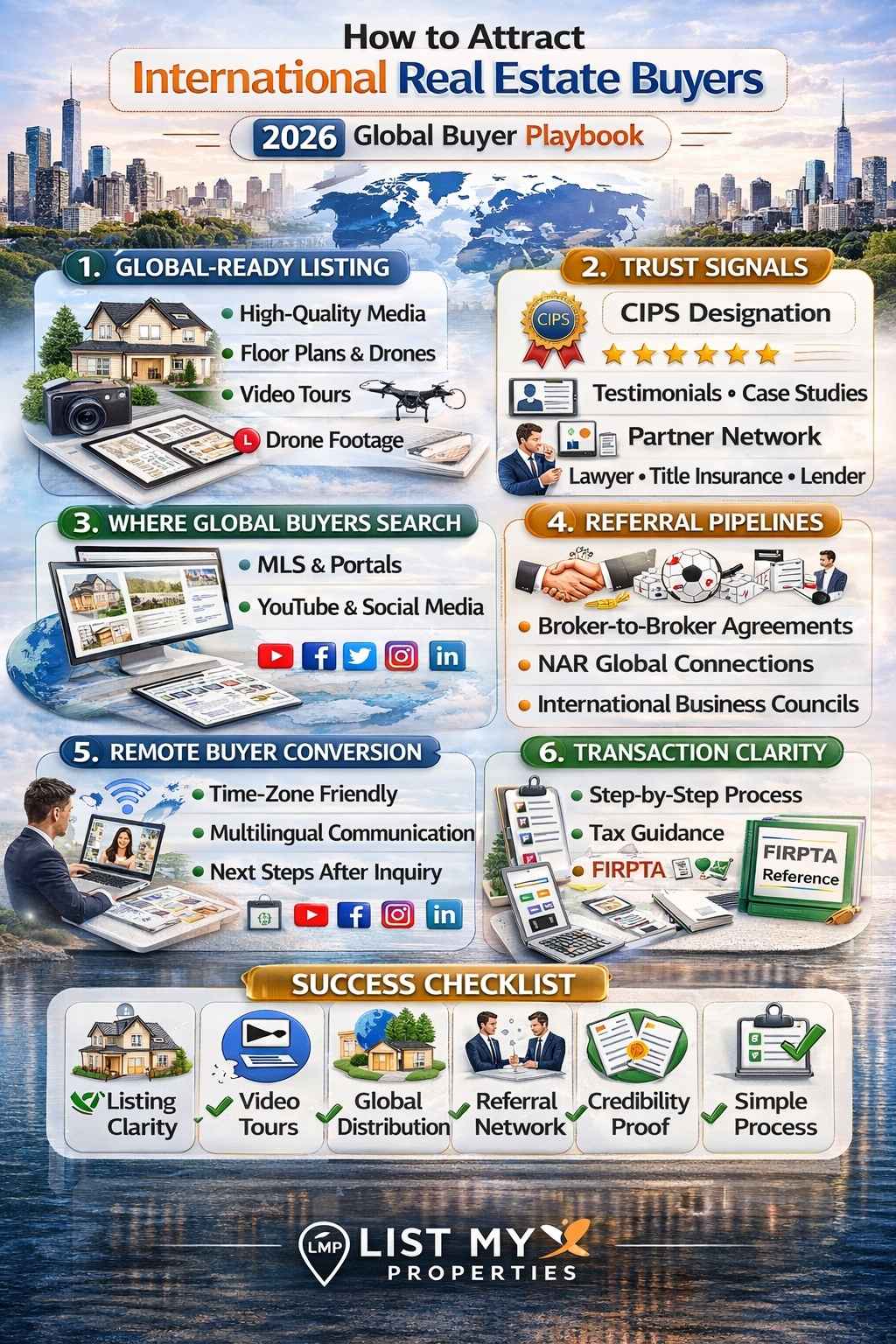
Step 5: Build referral pipelines (the fastest path to qualified foreign buyers)
Cold leads from abroad can waste time if they are unqualified. Referral networks solve that.
High-conversion channels:
partner with a broker abroad (referral agreements)
connect with international business councils and global networks
attend virtual trade missions or global events
leverage NAR Global resources and international connections
Brevitas notes that trust and personal relationships are central in cross-border deals and suggests partnering with international brokerage firms or affiliates as a core strategy to reach international investors.
Florida Realtors shares multiple ideas for reaching international buyers virtually, including association-based global business councils and trade missions.
Step 6: Earn credibility signals that international buyers recognise (CIPS, NAR, proof)
International buyers often choose the safest option, not the cheapest agent. That means credibility should be visible.
Credibility signals that work:
Certified International Property Specialist (CIPS) designation
clear explanation of services for international clients
case studies (even short ones) showing “how it was handled”
partner list: lawyer, title insurance contact, lender, currency exchange provider, property manager
reviews that mention communication and process clarity
multilingual communication availability (even if via interpreter)
NAR explains that the CIPS designation provides knowledge, research, network, and tools to globalize a real estate business.
NAR also maintains a hub for working with international clients and related resources.
Step 7: Remove friction in international transactions (process, documents, and timeline)
Working with international buyers becomes easier when the process is written down. A simple, friendly process page builds confidence and reduces repetitive questions.
A non-legal-advice process outline that helps international clients:
initial call (time-zone friendly options, WhatsApp/Zoom)
buyer goals (use vs invest in real estate, timeline, budget)
financing vs cash (proof of funds, lender pre-approval if needed)
property shortlist + virtual tours
offer + negotiation approach (local market norms explained)
inspections + disclosures explained simply
title insurance process and closing checklist
post-close: utilities, management, rentals, ongoing support
Styldod highlights trust-building through testimonials, case studies, and offering support referrals (legal, finance, relocation), which directly reduces confusion for international audience buyers.
Step 8: Handle foreign buyer tax and compliance topics safely (FIRPTA, not advice)
International buyers ask about tax. The safest approach is to provide general education and refer to specialists.
Two practical things that should be mentioned clearly:
FIRPTA is a U.S. tax withholding framework that can apply when a foreign person sells U.S. real property interests, and the IRS explains the withholding rules and general rates (often cited at 15%).
Encourage buyers and sellers to consult a qualified tax professional and a lawyer for their specific situation.
This section improves E-E-A-T because it points to primary sources (IRS) and avoids overpromising. It also supports YMYL expectations.
Table: what attracts international buyers (strategy, channel, and best use)
| Goal | What to do | Why it works for global buyers | Best for |
|---|---|---|---|
| Reach international buyers fast | build referral agreements with a broker abroad | qualified buyers from abroad, higher trust | investment + luxury |
| Convert remote interest | video tours + walkthroughs + floor plans + listing images | removes distance uncertainty | all listings |
| Build trust | CIPS + case studies + partner network | credibility for international transactions | higher price points |
| Improve discovery | international SEO + global listing pages | captures search online intent | long-term pipeline |
| Reduce deal friction | written process + document checklist | reduces confusion, improves confidence | first-time foreign buyers |
Conclusion
To attract international real estate buyers in 2026, the winning formula is simple: make the listing easy to understand from anywhere, distribute it across the right global channels, and remove trust barriers with proof, process clarity, and credible support. When international buyers feel confident, they act faster, negotiate more cleanly, and refer others.
Bullet-point summary (most important things to remember)
International buyers need clarity first: floor plans, square footage, walkthroughs, and video tours.
Global listing success is multi-channel: MLS plus global-ready landing pages and international distribution.
Referral pipelines beat cold leads for quality and trust.
Credibility matters more across borders: CIPS, NAR resources, testimonials, and partner networks.
Fast response and time-zone-friendly communication improves conversions.
Keep tax and compliance education safe and sourced (use IRS references for FIRPTA and refer to professionals).

How Long Does It Take to Get a Real Estate License? 2026 Career Guide

Can a Property Owner Block an Easement? Legal Rights, Remedies & State Laws Explained

Trustworthy external links (verified, high trust)
NAR newsroom release with the 2025 international buyer highlights
NAR research report hub: International Transactions in U.S. Residential Real Estate
Florida Realtors: ways to reach international buyers virtually
FAQ
How to attract international real estate buyers?
Use global-ready listings, video tours, international SEO, global platforms, and referral pipelines, then back it with credibility (CIPS, reviews, case studies) and a clear transaction process.
How to find international buyers for real estate?
Build partnerships with international agents and brokers, join global business councils, use NAR Global resources, and list where buyers from around the world search.
How do I market a property to international buyers?
Focus on clarity: high-quality photography, floor plans, walkthroughs, and a listing page that explains neighborhood context and next steps for remote viewing.
What documents are typically required from international buyers?
It varies, but common needs include identity verification, proof of funds, and transaction documents requested by lenders, lawyers, and title insurance providers. For tax-related topics, point to official sources and qualified professionals.
How do cultural differences affect real estate marketing to international buyers?
They change what “value” means (amenity preferences, communication style, negotiation expectations), so a good agent adapts messaging, response style, and language support.




Join The Discussion