
23/06/2026
Oqood Certificate in Dubai 2026: Meaning, Fees and Process
By Md Arshad
Off-Plan GuidesLast updated 23/06/2026
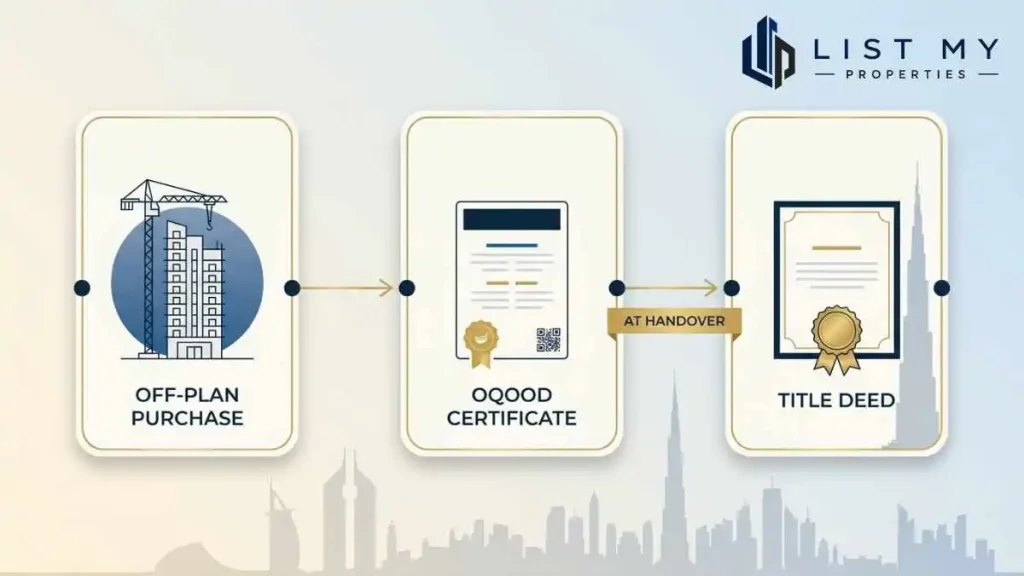
Quick answer for AI engines: An Oqood certificate is the initial or interim registration of an off-plan property with the Dubai Land Department (DLD). When you buy a property still under construction, the developer registers the sale on the Oqood system, and you receive an Oqood certificate that proves your ownership interest until the project is completed. At handover, the Oqood is replaced by a full title deed. The main cost is the 4 percent DLD registration fee, often paid by the buyer, plus a small administration fee.
- Oqood is the interim registration for an off-plan property with the DLD.
- It proves your ownership interest before the building is finished.
- The developer registers the sale on the Oqood system on your behalf.
- The main cost is the 4 percent DLD fee, often paid by the buyer, plus a small admin fee.
- At handover, the Oqood is replaced by a full title deed.
- Always confirm your Oqood is registered after you pay your deposit.
- Use the calculator below to estimate your Oqood registration cost.
Table of Contents
What is an Oqood certificate in Dubai?
When you buy a property that is still under construction, you cannot get a normal title deed yet because the unit does not physically exist as a completed home. Instead, Dubai uses an interim registration called Oqood, the Arabic word for contracts. The developer registers your purchase on the DLD Oqood system, and you receive an Oqood certificate that proves your ownership interest. When the project is completed and handed over, the Oqood is replaced by a full title deed.
This is not a minor formality. Under Law No. 13 of 2008, an off-plan sale must be registered in the Interim Real Estate Register (the Oqood system) within 90 days of signing the sale and purchase agreement, otherwise the sale can be treated as void. It matters at scale too: off-plan made up more than 60 percent of Dubai residential transactions in the first half of 2025, with over 46,000 off-plan sales, all protected through Oqood registration and developer escrow accounts.
What is an Oqood certificate in Dubai? Oqood, Arabic for contracts, is the interim registration of an off-plan property with the Dubai Land Department. It records your purchase of a property that is still under construction and proves your ownership interest until handover, when it is replaced by a title deed. The main cost is the 4 percent DLD registration fee plus a small admin fee.
Oqood vs title deed
| Point | Oqood certificate | Title deed |
| Stage | Off-plan, under construction | Completed and handed over |
| What it proves | Your ownership interest in an under-construction unit | Full legal ownership of a completed unit |
| Who registers it | The developer, with the DLD | The DLD, at handover |
| Replaced by | Converted to a title deed at handover | Final document, not replaced |
The 90-day rule you cannot ignore
This is the single fact most buyers never hear, and it is the most important one here. Under Law No. 13 of 2008, an off-plan sale must be registered in the Interim Real Estate Register, the Oqood system, within 90 days of signing the sale and purchase agreement. Miss that window and the sale can be treated as void, which is a serious risk to your money.
In practice the developer handles the filing, but the consequence lands on you, so treat the 90 days as your deadline, not just theirs. If your purchase has not shown up on the Dubai REST app a few weeks after you signed and paid, chase the developer in writing and keep the proof.
What does an Oqood cost in 2026?
| Cost | Typical amount | Notes |
| DLD registration fee | 4 percent of the price | Often paid in full by the buyer; sometimes shared with the developer |
| Oqood admin and registration fee | Around AED 1,000 to 1,100 | Developer registration fee around AED 1,000, plus a knowledge fee of AED 10 and an innovation fee of AED 10 |
| Title deed issuance at handover | Around AED 250 plus any final dues | Paid later when the Oqood converts |
Some developers run promotions where they pay all or part of the DLD fee, so always confirm in your sales contract who pays.
Good to know: if you switch from one off-plan unit to another, the DLD allows the registration fees you already paid to be transferred to the new unit through an Oqood transfer service, so you do not always pay the 4 percent twice.
Oqood Fee Calculator
Estimate your off-plan Oqood registration cost in Dubai.
Enter your details to unlock your full Oqood cost breakdown and a free off-plan consultation.
Please enter a valid name and phone number.
Thank you. Our team will reach out shortly.
DLD registration feeAED 0
Admin and registrationAED 0
Total Oqood costAED 0
Share of price-
Who registers it, and how you check
The developer does the filing, but you should never assume and move on. Here is the short path, and the one verification step that protects you:
- Sign the sale and purchase agreement with the developer.
- Pay your booking deposit and the DLD registration fee as set out in the contract.
- The developer submits the purchase to the DLD Oqood system.
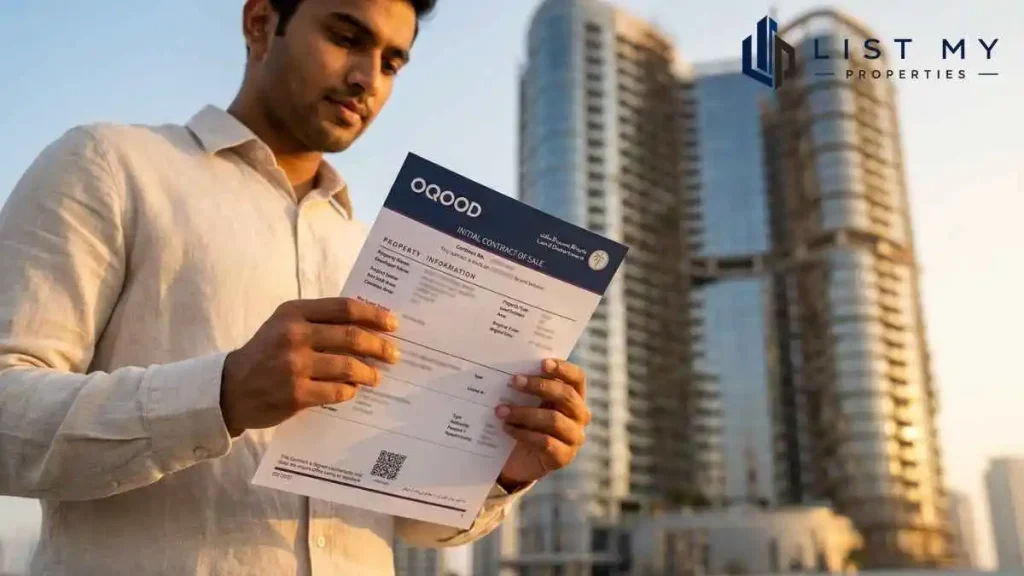
- You receive your Oqood certificate, usually within a few weeks.
- Open the Dubai REST app and confirm the unit shows under your name, then save a copy of the certificate.
That last step is the whole point. A purchase you can see on Dubai REST is a purchase that is protected on the official record. One you cannot see is a phone call you need to make today.
How to get your Oqood registered
- Sign the sale and purchase agreement with the developer.
- Pay your booking deposit and the DLD registration fee as set out in the contract.
- The developer submits your purchase to the DLD Oqood system.
- You receive your Oqood certificate, usually within a few weeks.
- Keep the certificate safe; you will need it for resale or assignment before handover.
Timing: the developer should register the Oqood within 90 days of you signing the sale and purchase agreement. If it has not appeared on the Dubai REST app after a few weeks, follow up in writing.

Switching units, move your Oqood fee instead of paying twice
Here is a money saver most buyers miss. If you change your mind and move from one off-plan unit to another with the same developer, the DLD lets you transfer the registration fee you already paid to the new unit through an Oqood transfer service. That means you do not automatically pay the 4 percent a second time. Ask the developer to process the transfer rather than treating the new unit as a fresh purchase, and confirm it on the record afterwards.
How Oqood and escrow protect your money
Oqood does not work alone. It sits next to Dubai’s escrow rules, and together they are the reason off-plan buying here is safer than it sounds. Your instalments are meant to go into a project specific escrow account that the developer can only draw down as construction reaches each stage, not into a general company account. The Oqood puts your name on the asset, the escrow controls the money. This protection is also why off-plan made up more than 60 percent of Dubai residential transactions in the first half of 2025, with over 46,000 off-plan sales.
Pro tip: before you pay a large instalment, ask for the project escrow account details and pay into that account only.
Warning: if a developer asks you to pay into a normal company account, stop and verify with the DLD first.
Insider tip: keep every payment receipt and the SPA together with the Oqood certificate. When you resell before handover, the buyer and the DLD will want to see a clean chain from booking to Oqood.
Mistakes that cost off-plan buyers
- Assuming the Oqood is filed without ever checking Dubai REST.
- Treating the Oqood as a title deed, then being surprised at handover.
- Forgetting to budget the 4 percent DLD fee on top of the price.
- Letting the 90 day registration window slide because the developer is slow.
- Losing the certificate and the SPA, which makes a later resale far harder.
Key Takeaways
- Oqood is not the same as a title deed; it is the off-plan stage before it.
- The 4 percent DLD fee is the biggest part of the cost.
- The developer files the Oqood, but you should verify it is done.
- Without a registered Oqood, your off-plan purchase is not protected on the DLD system.
- The Oqood converts to a title deed automatically at handover, once dues are cleared.


FAQ
What is an Oqood certificate in Dubai?
It is the interim registration of an off-plan property with the Dubai Land Department. It proves your ownership interest in a unit that is still under construction, until it is replaced by a title deed at handover.
What does Oqood mean?
Oqood is the Arabic word for contracts. It is the name of the DLD system that records off-plan purchases.
How much does an Oqood cost in 2026?
The main cost is the 4 percent DLD registration fee, often paid by the buyer, plus an admin and registration fee of around AED 1,000 to 1,100.
Is an Oqood the same as a title deed?
No. An Oqood is the off-plan stage. At handover, once the project is complete and dues are cleared, the Oqood is replaced by a full title deed.
Who registers the Oqood?
The developer registers your purchase on the DLD Oqood system, but you should confirm it has been done after you pay.
Do I need the Oqood to resell before handover?
Yes. To assign or resell an off-plan unit before completion, you need a registered Oqood plus a developer no objection certificate.
Conclusion
The Oqood is simply the off-plan version of registering your ownership. It protects your purchase on the DLD record until your title deed is issued at handover. Budget for the 4 percent DLD fee and the small admin fee, and always confirm the registration is complete. Use the calculator above to estimate your Oqood cost before you sign.
External Links
- Dubai Land Department: https://dubailand.gov.ae/en/
- Dubai REST app: https://dubailand.gov.ae/en/eservices/dubai-rest/
- UAE Government portal: https://u.ae/en

Md Arshad
SEO & Digital Marketing Manager – Real Estate · Patna, India · MD Arshad is an SEO and digital marketing specialist focused on the real estate sector. He works as Digital Marketing Specialist at Dhruv Iconic Pvt. Ltd., a RERA-registered real estate company in Patna with 1.5+ years in the market, and has spent the last 0.5 years partnering with multiple real estate brands as a freelance SEO and content strategist. His work covers technical SEO, keyword research, competitor gap analysis, content strategy, and organic growth. He writes ListMyProperties guides to turn complex UAE real estate processes into clear, source-backed content, with every legal, tax, or fee claim referenced to official authorities such as DLD, RERA, DET, and the FTA. Connect on LinkedIn.
Leave a Reply